Canada Arrival Card: How to Fill Out the Advance CBSA Declaration for Filipinos
Flying from the Philippines to Canada? You may have heard about the Canada Arrival Card, but the official online option is called the Advance CBSA Declaration. It allows travelers to submit their customs and immigration declaration before arriving at participating Canadian airports. Here's what Filipino travelers need to know about the requirements, online submission, and arrival process.
What Is the Canada Arrival Card?
The Canada Arrival Card refers to the customs and immigration declaration that travelers complete when entering Canada. The official online option is called the Advance CBSA Declaration, available through the ArriveCAN app or website.
This free service, provided by the Canada Border Services Agency (CBSA), allows eligible travelers to submit their information up to 72 hours before arrival at participating Canadian airports. After landing, travelers can review and confirm their declaration at an airport kiosk or eGate.
The Advance CBSA Declaration is optional and does not replace a Canadian visa or eTA. Travelers who do not submit it in advance must still complete their customs declaration upon arrival.
Official website: Canada Border Services Agency (CBSA)
⚠️ Important: The Advance CBSA Declaration is optional, but all travelers must still complete the required customs and immigration declaration when entering Canada.


Is the Canada Arrival Card Required for Filipinos?
No. Filipino travelers are not required to submit the Advance CBSA Declaration before traveling to Canada.
However, using ArriveCAN can make the arrival process more convenient at participating airports.
Filipino travelers may use the service when:
- Arriving at a Canadian airport that supports Advance CBSA Declaration.
- Traveling with a valid passport.
- Visiting Canada for tourism or to see family and friends.
- Entering Canada for an approved study or work purpose.
- Meeting the applicable entry requirements.
Travelers who do not submit the declaration in advance can complete their declaration upon arrival using an airport kiosk, eGate, or paper declaration card, depending on the airport.
Which Canadian Airports Accept Advance CBSA Declaration?
The following airports participate in the Advance CBSA Declaration program:
| Canadian Airport | Airport Code |
|---|---|
Toronto Pearson International Airport | YYZ |
Vancouver International Airport | YVR |
Montréal-Trudeau International Airport | YUL |
Calgary International Airport | YYC |
Edmonton International Airport | YEG |
Ottawa International Airport | YOW |
Winnipeg Richardson International Airport | YWG |
Halifax Stanfield International Airport | YHZ |
Québec City Jean Lesage International Airport | YQB |
Billy Bishop Toronto City Airport | YTZ |
At Toronto Pearson, the service is available in Terminals 1 and 3. eGates are currently available in Terminal 1.
For the latest participating locations, check the official CBSA airport list.
How to Fill Out the Canada Arrival Card Online
Filipino travelers can submit their Advance CBSA Declaration using the official ArriveCAN mobile app or website.
The process is free and can be completed up to 72 hours before arriving in Canada.
Step 1: Open the Official ArriveCAN Platform
Access ArriveCAN through either option:
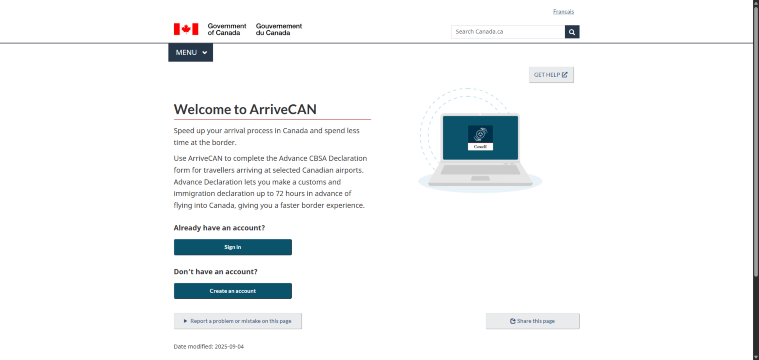
- Website: Official ArriveCAN
- Mobile app: Download ArriveCAN from the Apple App Store or Google Play.
Use only the official Government of Canada website or app to protect your personal information.
Step 2: Create an ArriveCAN Account
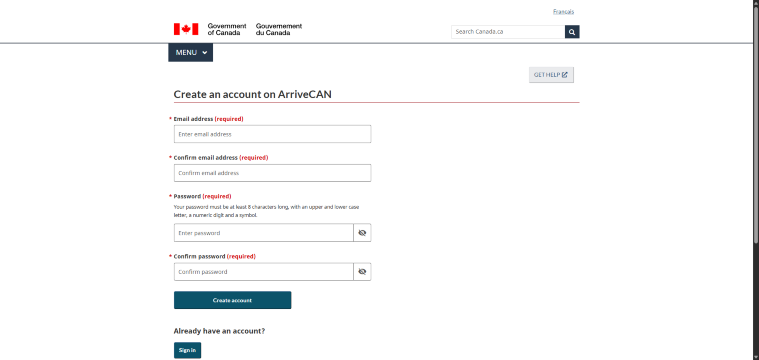
If you're using ArriveCAN for the first time, create an account.
- Enter a valid email address.
- Create a secure password.
- Check your email for the verification code.
- Enter the six-digit code to activate your account.
- Sign in to continue.
If you already have an ArriveCAN account, simply sign in using your existing details.
Step 3: Enter Your Passport Information
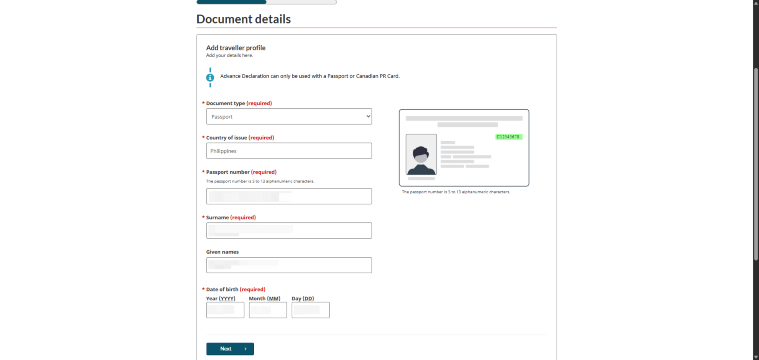
Create your traveler profile using your Philippine passport.
You'll need to provide information such as:
- Full name
- Date of birth
- Nationality
- Passport number
- Passport details requested by the system
Make sure the information matches your passport exactly.
You can manually enter your passport details or use the app's passport-scanning feature.
Note: Use the same passport when you arrive in Canada.
Step 4: Complete Your Advance CBSA Declaration
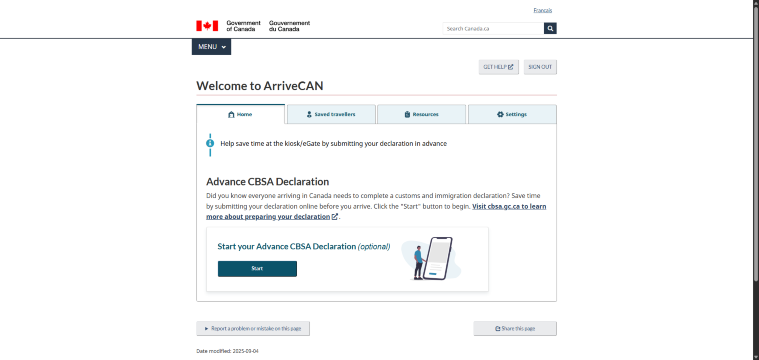
Select the Advance CBSA Declaration feature and follow the instructions.
Provide the requested travel information, including your arrival details and the relevant customs and immigration information.
Have your flight itinerary ready so you can check your arrival airport and travel details.
Step 5: Answer the Customs Questions
You'll need to declare the goods and items you're bringing into Canada.
Questions may cover:
- Food and agricultural products.
- Meat, fish, seafood, and other animal products.
- Plants, seeds, and related products.
- Goods purchased abroad.
- Gifts or items intended for other people.
- Currency and monetary instruments valued at CAN$10,000 or more.
Read each question carefully and answer honestly.
⚠️ Important: If you're bringing Filipino food or pasalubong, including dried fish, meat products, or packaged snacks, declare the items. Some products may be restricted or prohibited.
Step 6: Review and Submit Your Declaration
Before submitting:
- Double-check your passport information.
- Review your customs answers.
- Confirm that your travel details are correct.
- Submit the declaration.
After successful submission, ArriveCAN displays a confirmation screen and sends a confirmation email with a reference number.
Keep the confirmation email for your records.
Step 7: Confirm Your Declaration After Landing
Your Advance CBSA Declaration is not the final step.
After arriving at a participating Canadian airport:
- Proceed to the designated airport kiosk or eGate.
- Scan your passport or accepted travel document.
- Review your previously submitted declaration.
- Update your answers if anything has changed.
- Confirm and submit your final declaration.
- Take the receipt to a border services officer for further processing.
The system retrieves your submitted declaration using your travel document.
You do not normally need to present a screenshot of your ArriveCAN confirmation as a separate entry document.
 NO.1





















































What Documents Do Filipinos Need to Enter Canada?
Before traveling, Filipino passport holders should prepare the appropriate documents for their visit.
| Document | Requirements |
|---|---|
Valid Philippine passport | Must be valid and accepted for travel to Canada |
Canadian visitor visa or eTA | Depends on your eligibility and travel circumstances |
Flight itinerary | Keep your booking confirmation and travel details |
Accommodation details | Hotel confirmation or address of your host |
Return or onward ticket | Useful evidence of your intended departure |
Proof of sufficient funds | May be requested by a border officer |
Invitation letter | If visiting relatives, friends, or attending an invited event |
Study or work documents | If traveling for an approved study or work purpose |
Advance CBSA Declaration | Optional, for eligible airport arrivals |
Passport Validity
Canada requires travelers to have a valid and accepted passport or travel document.
IRCC's visitor visa application guidance recommends that passports be valid for at least six months from the planned travel date.
However, this recommendation should not be confused with a universal six-month entry rule.
Travelers should also check Philippine departure requirements and any requirements imposed by transit countries or airlines.


Do Filipinos Need a Visa or eTA to Enter Canada?
Most Filipino travelers need a Canadian visitor visa. However, certain Philippine passport holders can apply for an Electronic Travel Authorization (eTA) instead.
Since June 6, 2023, eligible Filipino travelers have been able to apply for an eTA when traveling to Canada by air.
Canada Visa vs. eTA for Filipinos
| Travel Situation | Entry Document |
|---|---|
Filipino traveler with a valid Canadian visitor visa | Use the existing visa |
Held a Canadian visitor visa within the past 10 years and traveling by air | May qualify for an eTA |
Holds a valid US nonimmigrant visa when applying for an eTA and traveling by air | May qualify for an eTA |
Does not meet eTA eligibility requirements | Visitor visa required |
Entering Canada by car, bus, train, or boat | Visitor visa generally required |
Traveling for work or study | Appropriate authorization and travel documents required |
Who Is Eligible for a Canada eTA?
Filipino travelers may qualify if they meet all the following conditions:
- Hold a valid Philippine passport.
- Travel to or transit through Canada by air.
- Visit Canada temporarily, normally for up to six months.
- Have held a Canadian visitor visa within the past 10 years or currently hold a valid US nonimmigrant visa when applying.
The official eTA application fee is CAN$7.
An approved eTA is electronically linked to your passport.
⚠️ Important: An eTA is not the same as the Advance CBSA Declaration. The eTA is a travel authorization, while Advance CBSA Declaration is an optional customs and immigration declaration service.
What Must You Declare When Arriving in Canada?
Canada has strict customs and agricultural import rules. Travelers must accurately declare the goods they're bringing across the border.
Food and Pasalubong
Filipino travelers visiting relatives or friends may bring food or gifts from the Philippines.
However, some items are restricted or prohibited.
Products that must be declared include:
- Meat and meat products.
- Fish and seafood.
- Fruits and vegetables.
- Seeds and plants.
- Homemade food.
- Processed or canned food.
- Dairy products.
Declaring an item does not automatically mean it is prohibited. Border officers will determine whether it can enter Canada.
Cash and Monetary Instruments
Travelers carrying CAN$10,000 or more, or the equivalent in other currencies, must declare the amount.
This requirement includes certain monetary instruments, such as checks, money orders, and bank drafts.
Carrying that amount is not illegal, but failing to declare it may result in penalties or seizure.



What Happens After Arriving in Canada?
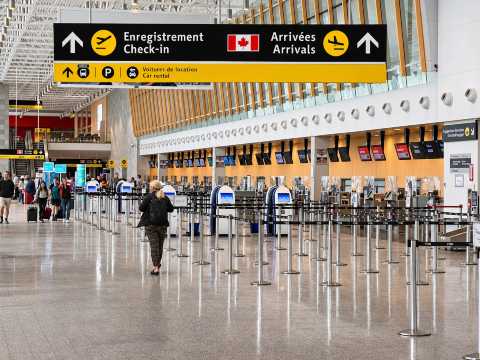
After landing, follow the airport signs for immigration and customs.
Step 1: Proceed to Immigration and Customs
If you submitted your Advance CBSA Declaration, proceed to the appropriate kiosk or eGate.
Otherwise, complete the required declaration at the airport.
At airports without kiosks or eGates, a paper declaration card may be provided on the aircraft or upon arrival.
Step 2: Verify Your Identity
Present your passport and complete the required identity verification process.
Depending on your circumstances, you may also need to provide your visa, eTA-related travel document, or supporting documents.
Step 3: Speak With a Border Services Officer
A CBSA officer may ask questions about:
- The purpose of your visit.
- Your intended length of stay.
- Where you'll be staying.
- Your return plans.
- Your financial arrangements.
Answer clearly and provide any documents requested.
Step 4: Collect Your Baggage
After completing the required arrival procedures, collect your checked luggage.
Follow customs instructions and report any items that require further inspection.
Step 5: Leave the Airport
Once you've been cleared by the border authorities, proceed to the arrivals area.
You can then take a taxi, airport train, bus, or other available transportation to your accommodation.
- One way
- Round-trip
 MNL9:15 PM36h 25m1 stopsYVR6:40 PMManila - Vancouver|Wed, Dec 2|Xiamen AirlinesTHB 11,440THB 14,94023% offSearch23% offTHB 14,940THB 11,440
- MNL9:15 PM36h 25m1 stopsYVR6:40 PMManila - Vancouver|Wed, Nov 18|Xiamen AirlinesTHB 11,490THB 14,94023% offSearch23% offTHB 14,940THB 11,490
- MNL9:15 PM36h 25m1 stopsYVR6:40 PMManila - Vancouver|Fri, Nov 20|Xiamen AirlinesTHB 11,650THB 14,94022% offSearch22% offTHB 14,940THB 11,650
 MNL13:0036h 25mNonstopYVR14:00Manila - City|Mon, Sep 6|Normal AirlineFind more flightsFind more flights
Tips for Filipino Travelers Arriving in Canada
Before flying from the Philippines to Canada, keep these practical tips in mind for a smoother arrival.
Prepare Your Travel Documents
- Check that your Philippine passport and Canadian visa or eTA are valid.
- Keep your flight tickets, hotel bookings, and travel itinerary accessible.
- Prepare your host's address and contact details if visiting family or friends.
- Check the entry and transit requirements for countries where you have connecting flights.
Check Your Luggage Before Packing
- Declare all food, plant, and animal products, including pasalubong.
- Check Canada's customs regulations before bringing dried food, meat products, or packaged snacks.
- Declare cash and monetary instruments totaling CAN$10,000 or more.
Confirm Your Arrival Airport
- Check your first airport of entry into Canada, especially if you have connecting flights.
- Confirm whether the airport supports the Advance CBSA Declaration.
- Allow enough time for immigration, customs, baggage collection, and connecting flights.
Keep Important Information Accessible
- Save digital copies of your passport details, flight itinerary, and hotel confirmation.
- Keep your ArriveCAN confirmation email and reference number for your records.
- Download important travel information so you can access it without Wi-Fi.
- Save your accommodation address and emergency contact numbers.
FAQs About the Canada Arrival Card
-
What happens if my flight to Canada is delayed?
-
Can I correct a mistake after submitting my declaration?
-
Do I need to print my ArriveCAN confirmation?
-
What if I cannot access ArriveCAN before my flight?
-
Can I use the Advance CBSA Declaration with a NEXUS kiosk?

Trending Searches
-
Popular Content
-
Top Flight Links
-
Popular Hotels
-
Popular Things to Do
-
Featured guides
-
Trip.com links
- Trip.com E-Ticket
- Trip.com Payment Methods
- Trip.com Passport Change
- Trip.com Customer Service
- Trip.com Flight Cancellation
- Trip.com VIP Lounge Access
- Trip.com Phone Number
- Trip.com Check In
- Payment Sale
- Trip Coins
- Trip.com Hotel Refund
- Trip.com Cancellation Policy
- Trip.com Ticket Issued Status
- Trip.com Flight Ticket
- Trip.com Membership
- Trip.com E-Receipt
- Trip.com Seat Selection
- Trip.com Baggage Allowance
- Trip.com Flight Change
- Trip.com Reviews
- Flights from Manila to Hong Kong
- Flights from Manila to Iloilo City
- Flights from Bacolod to Manila
- Flights from Manila to Tagbilaran
- Flights from Manila to Cebu
- Flights from Manila to General Santos
- Flights from Manila to Tokyo
- Flights from Cebu to Manila
- EK2521 Flight Status
- 5J187 Flight Status
- KN5896 Flight Status
- RX874 Flight Status
- PR741 Flight Status
- MH709 Flight Status
- 5J582 Flight Status
- Hotels near 72 wonder tower
- Hotels near Mactan–Cebu International Airport
- Hotels near Greenland Xindu East Coast Times Square South Area
- Hotels near Fenghuang Ancient Town
- Hotels near Taoyuan HSR Subway Station
- Shiji Qingteng Capsule Hotel (T3 Terminal)
- De Mani Hotel
- Alta Vista de Boracay
- Shangri-La Resort
- Shangri-La Hongqiao Airport, Shanghai
- Hotels in Fenghuang County
- Hotels in Hong Kong
- Hotels in Davao City
- Hotels in North Jakarta
- Hotels in Moscow
- Philippines 5G eSIM | Dual Network • All AI & TikTok | Day Pass/Total Data Package | 24-Hour Billing | 1-30 Days | QR Code
- Private Mutianyu Great Wall Trip With English-speaking Driver
- Vietnam | 4G/5G eSIM | Daily/Data Plan | 24-hour Billing | 1-30 Days | QR code
- Taoyuan International Airport | Terminal 2 VIP Lounge Service | Oriental Club Lounge
- Sofitel Macau at Ponte 16 Buffet | Mistral Restaurant Lunch/Dinner Buffet
- Mainland China/Hong Kong/Macau 5G eSIM | 5 Carriers | Day Pass/Total Data Package | 24-Hour Billing | QR Code
- Huanglongjiuzhai Railway Station - Jiuzhaigou National Park shuttle bus · private charter optional
- Mutianyu Great Wall Day Trip & Includes Chairlift/Toboggan Ticket / Private Car Rental Available for 2 People or More
- Chamonix & Mont Blanc Guided Day Trip with SkyView Panoramic bus
- Small Group: Zambezi National Park Guided Game Drive
- St. Julian's: Parasailing Flight with Photos and Videos
- Small Group Dolphin Kayak Eco-Tour
- Luoyang Peony Festival - In-depth Guided Tour with Local Experiences by Senior Bilingual Guide
- Glowing Plankton. Glass Bridge, White Temple & James Bond Island Views
- Chongqing • Ba state banquet | Immersive experience of a millennium-old imperial feast
- Mothers Day Gifts
- eSIM
- Hong Kong International Airport
- International Driving Permit
- Toronto Pearson International Airport
- Universal Studios Singapore
- Great Wall of China
- UK ETA
- Narita International Airport
- China Currency
- Changi Airport
- Schengen Visa
- Singapore MRT Map
- France Visa
- Ninoy Aquino International Airport