Things to do in Fenxi
Explore top experiences
Top 10 attractions in Fenxi
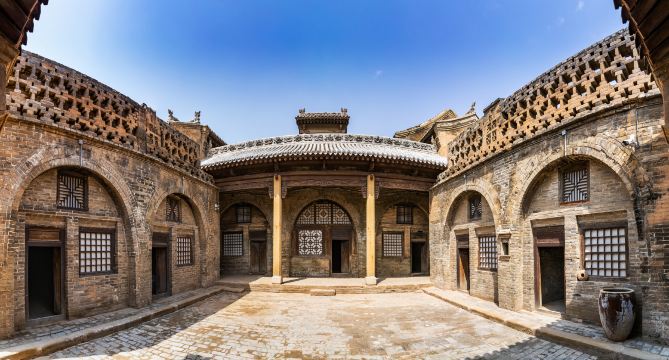
Courtyard of Family Shi
The cave dwellings in Shijiayuan were built in the 34th year of Emperor Qianlong's reign in the Qing Dynasty (1769). At that time, during the heyday of Emperor Qianlong, Shijia's family combined farming and business, and also operated banks and pawnshops, earning a lot of money. So they used the money to buy land, expand their family business, and build houses. It took them nearly 200 years to build a luxurious courtyard covering a large area. Its architectural style has typical northern and Shanxi residential features, and is divided into two parts: the main building and the ancillary buildings. The Shijia Courtyard has a total of 31 courtyards of various sizes, with quadrangle courtyards, two-entry quadrangle courtyards, second-floor quadrangle courtyards, and third-floor quadrangle courtyards as the main buildings, which are equipped with main rooms, living rooms, side rooms, halls, study rooms, embroidery towers, moon-viewing rooms, gatehouses, and stables for servants and other rooms. The most valuable art in Shijia Courtyard is the architectural sculpture art. Its wood carvings, stone carvings, and brick carvings are used to decorate the brackets, brackets, hangings, beams, screen walls, column bases, plaques, curtain frames, door covers, etc., with various styles and rich contents. For the character "Shou", there are as many as 108 different window lattice patterns. There are also many door plaques, plaques, and wood plaques, which are rare calligraphy works.Fenxi · 5.2 km from downtown


Luoyang Museum
The Luoyang Museum was established in 1958 and fully opened to the public on April 16, 2011. It is a comprehensive museum integrating cultural relic collection, exhibition display, and social education. Its collections span the long history of Luoyang as an ancient capital of thirteen dynasties. The main building stands like a giant ding (ritual vessel), symbolizing the "establishment of the capital in Luoyang." Its solemn and majestic facade itself serves as a popular photo backdrop. The large-scale permanent exhibition "Heluo civilization" unfolds along the timeline of prehistoric times, the Xia, Shang, and Zhou dynasties, the Han and Wei dynasties, the Sui and Tang dynasties, and the Five Dynasties and Northern Song period, connecting thousands of years of Luoyang's capital history into a complete viewing experience. The treasure hall on the second floor rotates displays of representative artifacts from the collection, including the Cao Wei white jade cup, the Northern Wei clay Buddha face sculpture, and the vividly expressive Northern Wei painted pottery figurine of two women holding hands, affectionately called the "best friends figurine" by visitors, all worth pausing to admire. In the Tang tri-color ceramics hall, the rare and majestic black-glazed tri-color horse and the massive Eastern Han stone artifacts are equally popular. The palace artifacts hall displays Qing Dynasty imperial artifacts transferred from the Forbidden City, including a golden nanmu wood tower carved from a single log and adorned with gilded miniature Buddhas, exuding royal grandeur. The stone carving hall is rustic and imposing, while the Wang Xiu peony art exhibition brings Luoyang peonies into paintings, each showcasing a unique blend of strength and delicacy. You can start your visit from the "Heluo civilization" exhibition and stone carving hall on the first floor, then proceed to the second floor to explore the treasure hall, Tang tri-color glazed pottery hall, and imperial artifacts hall in detail. The treasure hall features rotating exhibitions, and the specific exhibits are subject to the on-site display. A thorough visit typically takes two to three hours, so it is recommended to allocate sufficient time. Luoyang Museum consistently organizes flexible and diverse temporary exhibitions, continuously providing the public with new cultural offerings. It has introduced exotic-themed exhibitions such as "Civilizations of Qin-Han and Rome," "Norwegian style painting exhibition," "African cultural relics and art exhibition," as well as independently curated large-scale temporary exhibitions like "The starting point of the Silk Road - the Silk Road and Luoyang" and "The hub of the Grand Canal - the Grand Canal and Luoyang," enriching the exhibition content and ensuring visitors always find something new. Adhering to its mission of reaching out, Luoyang Museum has independently or collaboratively held cultural relic exchange exhibitions in over 20 countries and regions, including the United States, France, Japan, South Korea, Italy, Belgium, Sweden, and Australia, generating positive impacts both domestically and internationally. Luoyang Museum adheres to the organic integration of collection preservation, scientific research, and social education for balanced development. Practicing a people-oriented service philosophy, it enhances integration and interaction with society while excelling in exhibition reception and educational promotion. The museum actively recruits volunteers passionate about museum education, establishes cooperative units, and extends its reach to communities, schools, rural areas, and military camps to expand its coverage and influence. Additionally, it hosts monthly traditional culture lectures to disseminate heritage knowledge and cultivate museum audiences, achieving remarkable results. Luoyang Museum boasts a team of professionals with high academic standards. It has published numerous works and collections, with over 1,000 papers and representative publications including: "Han tombs at Shaogou in Luoyang," "Luoyang tri-colored glazed pottery of the Tang dynasty," "Bronze mirrors unearthed in Luoyang," "Han dynasty murals in Luoyang," "A collection of essays commemorating the 40th anniversary of Luoyang Museum," "Cultural treasures of Luoyang," "The charm of Luoyang—highlights of archaeological achievements in the Heluo region," "A history of the ancient capital Luoyang," "Research on Western Zhou bronze ware," "Heluo civilization," and more, all widely recognized by society and academia. In the era of promoting cultural development and prosperity, Luoyang Museum is bound to play an even greater role in the construction of socialist spiritual civilization.China · Luoyang

Shanxi Museum
"Five thousand years of history can be seen in Shanxi." Located on Binhe West Road in Taiyuan, the Shanxi Museum showcases the essence of Shanxi's cultural relics. The museum consists of a main building and four corner annexes, with the main building resembling both a dipper and a ding vessel, serving as the primary venue for travelers to view the collection. The main building has four floors. The first-floor lobby features a general service desk, while the second and third floors host thematic exhibitions on history and culture. The fourth floor showcases art-themed exhibitions, which together form the permanent displays of the Shanxi Museum. After entering the first-floor lobby, proceed to the second floor via the stairs to begin the historical journey themed "Soul of Jin." The cultural and historical thematic exhibition showcases the highlights of Shanxi's five-thousand-year civilization through numerous precious artifacts, ranging from ancient human relics to the rise and fall of Shanxi merchants during the Ming and Qing dynasties over five centuries. During your visit, several exquisite artifacts are not to be missed. The bird zun, a bronze ritual vessel from the Western Zhou period, was used in the ancestral temple sacrifices of the Jin marquis. The bird zun features an exquisitely crafted design with a phoenix as its main form. On the phoenix's back rests a small bird, serving as the handle for the vessel's lid. At the tail of the phoenix, an elephant is depicted, with its long trunk perfectly balancing the phoenix's two legs to form a stable tripod base. This artifact is a representative piece among the bronze collections in the museum. In addition, you can also admire: the Houma covenant texts, which are oath documents from the Spring and Autumn period used by the ministers of the Jin state; the lacquered wooden panel paintings, a painted screen from the Northern Wei dynasty depicting colorful stories from the "Biographies of Exemplary Women"; the white marble sarcophagus, a relic from the Sui dynasty, belonging to a tomb occupant who was a member of the Central Asian Yu people, with intricate carvings both inside and outside the sarcophagus, featuring figures with deep-set eyes, high noses, and black hair, characteristic of the Mediterranean Caucasian race. In the cultural thematic exhibition, you can also learn about the origins and development of Buddhism and traditional opera in Shanxi. The fourth floor of the main hall features an art thematic exhibition area. Among them, the "Timber and earth splendor" - ancient architectural art thematic exhibition showcases Shanxi's status as a province rich in cultural relics and ancient structures. "For above-ground relics, look to Shanxi" - Shanxi is renowned as the "treasure trove of ancient Chinese architecture," boasting over half of China's above-ground ancient structures with comprehensive categories, especially in the quantity of religious buildings. If you're a fan of ancient architecture, this is a must-visit. The Shanxi Museum also hosts temporary exhibitions periodically. At the first-floor lobby service desk, services such as hiring on-site guides (Chinese and English) and renting audio guides are available. The main building also houses a restaurant and a tea house for visitors.China · Taiyuan

Henan Museum
Located in the city of Zhengzhou, Henan Museum has a rich collection of exhibits displaying Henan's 5,000-year history and offering a window into traditional Henanese culture. The museum has eight exhibition halls that can be visited in chronological order. The collection includes several national treasures, including the lotus crane vase, cloud copper chest, Saohao vase, Jiahu bone flute, Wushu copper plate and more. Be sure to visit them all.China · Zhengzhou

Xinzhou Ancient City
Xinzhou was called Xiurong in ancient times. It is located between Taiyuan and Mount Wutai. It is the seat of Xinzhou Administrative Office and Prefectural Committee. In the Spring and Autumn Period, Xinzhou belonged to Jin State. In the Warring States Period, it belonged to Zhao State. In the Qin and Han Dynasties, it belonged to Taiyuan County, Yanmen County, and Taiping County. In the Sui Dynasty, it was Xinxingdu and Yanmen. During the Tang, Five Dynasties and Song dynasties, it was called Dingxiang Prefecture of Xinzhou. During the Jin, Yuan, Ming and Qing dynasties, it was called Xinzhou, Daizhou and Baodezhou. During the Anti-Japanese War and the War of Liberation, most of the area belonged to Jinchaji, and the area to the west belonged to Jinsui. In 1949, Xinzhou Prefecture was established. The cultural relics and historical sites in Xinzhou City include: Xinzhou North Gate Tower. Located in Xinzhou City, on the Gongchen Gate of the old north city wall. The North Gate Tower was built in the 24th year of Wanli in the Ming Dynasty. The tower is located on the 12-meter-high city wall, which makes it more majestic and magnificent. The city wall stands tall and is painted red on the outside. There is a Voucher doorway below, with a very high top and a bottom width of more than 3 meters.China · Xinzhou

Guangfu Ancient City
Guangfu Ancient Cityis located in Guangfu town, Yongnian district, Handan city, Hebei province. It is a national 5A-level attraction, a famous historical and cultural town in China, and a wetland park with profound historical heritage. Featuring beautiful northern water town scenery and a long-standing tai chi culture, it is China's unique ancient town, water town and tai chi town. The ancient town. Guangfu ancient town has a history of over 2,600 years, with its city walls stretching 4.5 km in circumference and covering an area of 1.5 square kilometers. The town boasts numerous historical relics, including two national-level protected sites - Guangfu ancient town itself and Hongji bridge, along with over 20 provincial and municipal protected sites such as the former residences of Yang Luchan, Wu Yuxiang and Wu Ruqing. The water town. Guangfu ancient town is located in the Yongnian depression covering an area of 46,000 mu. Surrounding the town walls is a 5 km moat that's 100 m wide, with wetlands beyond it. This "town between two waters" forms a unique view of Guangfu. The depression has perennial water accumulation with lush reeds, thriving fish and shrimp, lotus ponds, and migratory birds, earning it the reputation of "little Jiangnan in the north". The city of taiji. Guangfu ancient town is the birthplace of Yang-style and Wu-style taijiquan, where the founders of the two major schools, Yang Luchan and Wu Yuxiang, were born. It is a renowned hometown of taiji, from which taijiquan spread across China and the world.China · Handan

Taiyuan Ancient County
The ancient county seat of Taiyuan is located in Jinyuan District, covering an area of about 0.8 square kilometers. There are many relics of historical buildings in the city, the pattern of cross streets is clear, and the texture of streets and alleys is perfect. It follows the ancient architectural pattern of Jinyang ancient city "Phoenix Flying in the City", just like a phoenix with its head north and tail south. It has the reputation of "Phoenix City" since ancient times. It is the continuation of the 2500-year-old Jinyang ancient city. There are 79 existing cultural relics buildings in the city, and 49 historical buildings listed for protection by the Taiyuan Municipal Government. Among them, the Confucian Temple is listed as a national key cultural relics protection unit.China · Taiyuan

Baota Mountain
Baota Mountain is located in the center of Yan'an city, by the side of the Yan River, and is named after the pagoda on the mountain. The pagoda was first built in the Tang Dynasty, and the existing structure is a pavilion-style brick pagoda rebuilt in the Ming Dynasty. The pagoda, together with the mountain, the Yan River, and the bridge, forms the city skyline of Yan'an and is also a symbol of the revolutionary holy land in people's hearts. The poet He Jingzhi wrote in "Returning to Yan'an" the famous line, "How many times in my dreams have I returned to Yan'an, embracing Baota Mountain with both hands," adding emotional weight to this mountain. The mountain is densely scattered with historical sites, including Song dynasty cliff carvings, Fan Gong Well, beacon towers, Star-gazing Tower, Jialing Academy, ancient city walls, and the former site of the Japanese Workers' and Peasants' School. Among them, the inscriptions "Jialing Mountain" in clerical script and "My chest harbors tens of thousands of armored soldiers" by Fan Zhongyan of the Northern Song dynasty have long been renowned. An iron bell cast in the Ming dynasty still hangs beside the pagoda, which was used for timekeeping and alarms during the CPC Central Committee's Yan'an period. Ascending the mountain path to Star-gazing Tower and beacon tower areas offers panoramic views of Yan'an city and the Yan River. After nightfall, the mountain and pagoda illuminate, and gazing back at the lit pagoda from near Yan River Bridge remains a favorite photo spot for many travelers.China · Yan'an

Luoyi Ancient City
The ancient city of Luoyang is located in the old town of Luoyang. It is an ancient city and has many historical sites. "Luoyi" is the old name of ancient times in Luoyang. After the ancient capital of the 13th Dynasty, there proves Chinese culture. Walking in the ancient city of Luoyang, the city walls, ancient courtyards, old trees, these scenery is worthy to visit. The ruins of Wenfeng Tower, Confucian Temple and Tuoling Palace reflect the profound historical and cultural heritage of Luoyang.China · Luoyang

The Luoyang Museum of Ancient Tombs
The Luoyang Museum of Ancient Tombs is the world's first museum dedicated to ancient tombs. The museum is divided into three main exhibition areas: the historical tombs section, the Northern Wei imperial mausoleums, and the Henan mural gallery. It houses dozens of ancient tomb chambers from various periods in Chinese history, all relocated from their original sites and restored in the underground exhibition area according to their original burial structures. Visitors can closely observe and gain a multi-perspective understanding of the internal environment of ancient tombs, including tomb architecture, unearthed artifacts, tomb murals, brick carvings, and other cultural relics. Historical burial area The historical burial area is located in the eastern part of the museum, divided into above-ground and underground sections, serving as a distinctive and visitor-attracting feature of the museum. The above-ground structure is a complex of Han-style replica buildings, featuring exhibition rooms such as "models of typical tombs from the Xia, Shang, and Zhou dynasties" and "group sculptures depicting imperial funeral processions of the Han dynasty." The underground section houses 25 relocated and restored representative tombs from the Luoyang region, spanning from the Western Han to the Song and Jin dynasties, displaying approx. several hundred cultural relics along with a substantial quantity of murals. The various reconstructed tombs (chambers) in the underground section were all relocated as complete units. The bricks and stones in each tomb were numbered by archaeologists at the original site before being dismantled, then meticulously reassembled here to recreate their original appearance. The tomb chambers are spaced closely together, connected by passageways. You can walk through these corridors and move between chambers from different eras, each showcasing unique architectural styles that reflect an aspect of ancient Chinese architectural artistry. The tomb chambers also display numerous replicas of unearthed artifacts, such as pottery figurines and household utensils from the Northern Wei dynasty, as well as Tang dynasty tri-colored glazed pottery. The chambers further contain epitaphs from the Western Jin, Northern Wei, Tang, and Song dynasties, along with vibrant murals including scenes like exorcism rituals, a lady opening a door, and ascension to immortality—these are regarded as treasures of ancient painting art. Northern Wei imperial tombs Located in the western part of the Luoyang Museum of Ancient Tombs, this exhibition area features the "Luoyang Museum of Ancient Tombs - Jingling Mausoleum" of Emperor Xuanwu of the Northern Wei Dynasty as its centerpiece, along with the relocated and restored tombs of Prince Yuan Xun of Qinghe and Prince Yuan Cha of Jiangyang. The burial mound of the Luoyang Museum of Ancient Tombs - Jingling Mausoleum is circular, with a rammed earth pile over 20 m high. Visitors can walk down the passageway to the center of the burial chamber, where a coffin is placed, though it contains no items. The ceiling of Prince Yuan Xun's tomb is painted with an astronomical chart depicting over 300 stars. This chart, which predates the Dunhuang Star Atlas by approx. 400 years, is an invaluable material for studying ancient Chinese astronomy. Mural museum The Henan mural museum displays authentic tomb murals from multiple dynasties including the Western Han, Eastern Han, Wei-Jin, Tang-Song, and Jin-Yuan periods. These murals feature clear imagery and broad thematic content covering astronomy, geography, human affairs, and deities. The tomb owners range from emperors, concubines, and high-ranking officials to local petty officials and commoners.China · Luoyang
Experiences you can't miss in Fenxi
Featured Cultural experiences in Fenxi
View all Cultural experiences
Free cancellation
Instant confirmation
Book now for tomorrow
FromAED 60.48
FromAED 60.48
Free cancellation
Book now for today
FromAED 147.89
Free cancellation
Book now for tomorrow
FromAED 60.48
Featured Day tours in Fenxi
View all Day tours
Free cancellation
Instant confirmation
Book now for tomorrow
FromAED 499.78
Free cancellation
Instant confirmation
FromAED 562.25

Free cancellation
Instant confirmation
Book now for tomorrow
FromAED 499.78
Free cancellation
Instant confirmation
Book now for tomorrow
FromAED 437.31
Free cancellation
Instant confirmation
Book now for tomorrow
FromAED 406.07
Free cancellation
Instant confirmation
Book now for tomorrow
FromAED 374.84
Free cancellation
Instant confirmation
FromAED 473.81
Free cancellation
Instant confirmation
Book now for tomorrow
FromAED 374.84
Free things to do in Fenxi
Courtyard of Family Shi
Fenxi · 5.2 km from downtownLuoyang Museum
China · LuoyangShanxi Museum
China · TaiyuanHenan Museum
China · ZhengzhouXinzhou Ancient City
China · XinzhouGuangfu Ancient City
China · HandanTaiyuan Ancient County
China · TaiyuanBaota Mountain
China · Yan'anImmediate access, Book now for today, Cancel anytimeLuoyi Ancient City
China · LuoyangThe Luoyang Museum of Ancient Tombs
China · Luoyang
What travelers say about Fenxi

滇国剑客October 3, 2021
5.0
Like other courtyards, Shijia Courtyard has become a tourist attraction brand in Shanxi. Its historical and cultural value has become increasingly stronger with the passage of time and has been recognized by the majority of tourists.
Courtyard of Family Shi

M25***53October 19, 2026
5.0
There was a slight unpleasantness with the merchant's customer service when making the reservation, as I had booked a guided tour of the Longmen Grottoes, but the merchant's page description was incorrect and I requested a refund, which they refused. I only got a refund after contacting the platform's customer service. Because of this unpleasant experience, I didn't have high expectations for the tour. However, once inside the museum, Mr. Pei's explanation was truly dedicated, and he was a very kind person; it was clear he genuinely loved the experience. Special praise! 👍 He made up for the merchant's shortcomings! 👍
Luoyang Museum

Anonymous userOctober 7, 2026
5.0
The tour guide was attentive and incredibly friendly, covering everything he needed to, and explaining things in considerable detail. With so many people during the National Day holiday, his experience helped us squeeze in every possible moment, and surprisingly, the trip wasn't crowded at all. The Yungang Buddha and the VR tour of Wutai Mountain were definitely worthwhile, and the Yanmen Pass Great Wall and Wang Family Courtyard were also very enjoyable. The driver was fantastic, incredibly experienced, and knew many shortcuts to Xiaoxitian, taking us directly to the scenic area entrance and saving us a lot of walking. The small group size meant it wasn't crowded, and the hotel arrangements were quite reasonable. The Yingxian Wooden Pagoda, the Yanmen Sunset, and the Wang Family Brick Carvings were all breathtakingly beautiful. The local tour guide was completely transparent and honest. I highly recommend this Shanxi tour; if you want to see ancient architecture but are afraid of doing research, book this tour without hesitation.
Shanxi Museum

口口木南.October 17, 2026
5.0
I love Henan so much! It helped me understand and get to know Henan. The young lady who gave me the tour was very professional, and I really liked her. In short, this trip to Henan was definitely worth it!
Henan Museum
Anonymous userSeptember 17, 2026
5.0
This is the most spectacular iron flower display I've ever seen! The program was diverse and engaging, the host was witty, the audience interaction was lively, the iron flower workers were incredibly skilled, and the iron flowers were dazzling and colorful – the effect was absolutely stunning! Thumbs up! 👍👍👍
Xinzhou Ancient City
Anonymous userOctober 3, 2026
4.0
The hometown of Tai Chi has well-preserved ancient city walls and many performance programs, but it is still quite commercialized. During the National Day holiday, there are a lot of tourists, especially at night, which causes serious traffic jams.
Guangfu Ancient City

楚云霁月August 21, 2026
4.0
The old town was rather deserted. The art exhibition was quite nice, though a bit over the top. But the park at the exit was absolutely gorgeous. Winding paths led to secluded spots, and unexpected beauty unfolded.
Taiyuan Ancient County

夜阑月色溶溶October 7, 2026
5.0
Because we had children with us, we opted to take the sightseeing bus up and down, which was very relaxing. We got a close look at the pagoda, took photos, and learned about its history, especially the plaques at the north and south gates: "Soaring high above the heavens, overlooking the mortal world"—for over 1000 years, the pagoda has achieved this.
Baota Mountain

Soh Kien PengSeptember 23, 2026
5.0
From Yuntaishan, we boarded a bus bound for Luoyang. The journey was long — more than four hours on the road. We left at 2:30 pm and only arrived close to 7:00 pm, which meant our first day in Luoyang was largely consumed by travel. That evening, drained from the ride, I managed only a brief visit to Yingtianmen, illuminated against the night sky.The following day was devoted entirely to two of Luoyang’s most iconic sites: the Longmen Grottoes and the White Horse Temple. After exploring the temple, we caught bus no. 58 directly to Luoyi Ancient City. By then, the hours of walking through grottoes and temple grounds had left us physically exhausted. Still, the ancient city welcomed us with free admission and a promise of cultural immersion.Dinner was taken at a basement food court along Minzhu Street. By the time we finished, night had fallen, and Luoyi Ancient City had transformed. The streets glittered with lanterns, music pulsed through the air, and the atmosphere was electric. Crowds gathered near the lake to watch 天女散花 — the “Fairy Scattering Flowers” dance performance — though we chose not to linger.Luoyi Ancient City (洛邑古城) remains one of China’s most authentic living historic districts. Here, 3,000 years of dynastic history — from the Zhou to the Ming — can still be felt in its preserved city walls, pagodas, canals, and performances. It is not simply a relic of the past, but a vibrant cultural stage where history and daily life coexist.
Luoyi Ancient City

M36***24October 8, 2026
5.0
Teacher Meng's explanations were exceptionally good, making the visit very rewarding. However, the children in the group were extremely noisy, rolling around on the ground, and despite Teacher Meng's repeated reminders, it was no use. The parents also ignored it, which was quite frustrating. Kudos to Teacher Meng again; she is incredibly dedicated!
The Luoyang Museum of Ancient Tombs


