Things to do in Bozhou
Explore top experiences
Top 10 attractions in Bozhou


Cao Cao Underground Tunnel for Transporting Troops
The Cao Cao Underground Tunnel for Transporting Troops under the main streets of the old city of Bozhou, with Dayushou as the center, extends in all directions to the city outside. The entire tunnel is intertwined, varied and huge, known as the "Underground Great Wall," far exceeding the value of a complete ancient city retained on the ground. The relics unearthed from the tunnel include bullets, iron knives, porcelain, inkstones and others of the Han, Tang and Song Dynasties, which are of great significance to the study of ancient Chinese military architecture, military tactics and of Cao Cao's military approach.Bozhou · 3 km from downtown

Huaxilou
Huaxi Hall is also known as Shanxi-Shaanxi Hall, and Greater Lord Guan Temple. It is a place for the gathering of merchants from Shanxi and Shaanxi in Ming and Qing Dynasties. It enjoys a time-honored history. Since Guan Yu was from Shanxi, they built the Lord Guan Temple here. Huaxi Hall is dedicated and magnificent with many excellent color paintings and exquisite sculptures dated back to the reign of Qianlong. It is a key cultural relic protection unit. It boasts three distinctive features: the two flagpoles in the front gate, woodcarving and the gate.Bozhou · 4.5 km from downtown

Bozhou Ancient City
Bozhou City is a tourist attraction with rich cultural heritage, and visitors can reach it by bus. In Bozhou City, Huaxilou is a landmark attraction that cannot be missed. A few dozen yuan of tickets can appreciate the exquisite craftsmanship of the "three wonders" - cast iron flagpole, mountain gate brick carvings and wooden stage. It is recommended to arrive before 9 am to enjoy the tranquil beauty in the light and shadow of the early morning. The adjacent Nanjing Lane Money House is a well-preserved Qing Dynasty ticket house site, which is worth exploring. Cao Cao's Military Transport Road provides a unique experience of traveling through the thousand-year-old underground Great Wall, and the mysterious secret passage mechanism is amazing. It is recommended to wear non-slip shoes because some passages are low and need to bend over to pass. Bozhou Museum is open to the public free of charge. The Eastern Han Dynasty jade mortar and the Cao Cao clan tomb text bricks in the museum are precious exhibits that cannot be missed, revealing the historical code of the Three Kingdoms period. Bozhou Old Street is famous for its rich food, where visitors can taste authentic local flavors. In order to better experience the charm of Bozhou City, it is recommended to wear comfortable shoes to facilitate walking among the various attractions.Bozhou · 3.9 km from downtown

Huazu Temple
Bozhou Huatuo Memorial Hall is located in Anhui Province. It was built in the Tang and Song Dynasties and covers an area of 8,600 square meters. It is also known as Huatuo Temple and Huazu Temple. It is a temple dedicated to Huatuo. The memorial hall is composed of three courtyards: the temple, the former residence, and the ancient medicine garden. A large number of medical history documents and cultural relics are displayed inside. Today, the Huatuo Memorial Hall has become the world's academic center for Huatuo research.Bozhou · 3.7 km from downtown

Nanjing Alley Qianzhuang
Nanjing Alley Qianzhuang, located at No. 19, Nanjing Lane, Beiguan, Bozhou City, is a former private financial institution. In May 1998, it was designated as a key cultural relic protection unit by the Anhui Provincial Government. Bozhou has been a significant commercial hub since ancient times, with a thriving financial industry from the Ming and Qing Dynasties. By the late Qing Dynasty and early Republic of China, the city hosted 33 money houses. Built during the Qing Dynasty's Daoguang period, Nanjing Alley Qianzhuang was a branch of the Pingyao "Rising Sun Chang" bank, offering services like deposits, loans, and currency exchange. Unlike most money houses that were demolished, Nanjing Alley Qianzhuang remains well-preserved and serves as a museum. The site features over 30 buildings, including halls and offices, in a Chinese-Western architectural style. It hosts exhibitions on the history of Bozhou's money houses, providing valuable insights into commercial architecture and financial history.Bozhou · 4.2 km from downtown

Huatuo Baicao Garden
Hua Tuo Baicao Garden is located on the west side of Gujing Avenue in Bozhou City. It is the core project of Boyao Huahai Leisure and Sightseeing World. The project covers a total area of about 2,000 mu. There is a 17-meter earthen hill in the Attraction, named "Luming Hill", which originated from Cao Cao's "Short Song" "The deer is calling, eating wild apples." The hill is planted with colorful moss cherry blossoms, and around the hill are marigolds, petunias, cosmos, verbena, and lupine. There are a total of 200,000 lupines, which are very beautiful when in full bloom. There is also a lake at the foot of the mountain, named Qingnang Lake, which is named after Hua Tuo's Qingnang Sutra. Peach Blossom Island, beach leisure area, glass viewing plank road, sunny lawn, etc. are built around Qingnang Lake for tourists to relax and have fun. In addition, there are some hills in Hua Tuo Baicao Garden, named Huaqian Valley, where popular flowers such as pink muhly grass are planted, where you can play and "check in".Bozhou · 8.9 km from downtown

Bozhou Museum
Bozhou MuseumVery close to Bozhou Railway Station, it was first built in 1958. Many artifacts unearthed from local historical sites are housed in the museum. Many visitors may not know much about Bozhou, butBozhou Museumis the perfect place to learn about Bozhou's past and present.Bozhou MuseumThe exterior is modeled after Han dynasty architecture, with statues of famous figures associated with Bozhou, such as Shang Tang, Cao Cao, and Hua Tuo, standing at the entrance. Inside, the museum has two floors: the second floor is a temporary exhibition hall, and the first floor is the main exhibition hall. Most visitors explore the permanent exhibition on the first floor, themed "Travel Through Five Thousand Years – Exploring Bozhou's Cultural Origins," with artifacts arranged chronologically from prehistoric times to the modern era. The entrance hall is a large space featuring a massive oracle bone script model of the character "Bo." The Guohe Civilization Hall presents the prehistoric civilization discovered along the Guo River, the mother river of Bozhou. The Shang Tang Capital Hall introduces King Tang, the founder of the Shang dynasty, who established his capital in Bozhou. The Taoist Sacred Land Hall explains that Laozi, Zhuangzi, and the Taoist master Chen Tuan were all from Bozhou. Since these periods are so remote, the displayed artifacts are mostly pottery, stone fragments, simple jade pieces, and unearthed items from local attractions such as the Tomb of King Tang and the Zhuangzi Temple in Mengcheng County—all relatively plain. The Han and Wei Spirit Hall is a must-see, as it houses the treasured masterpieces. Bozhou is the hometown of Cao Cao, and this hall mainly displays artifacts excavated from the tombs of Cao Cao's family. These include a silver-threaded jade burial suit, a Han eight-knife jade pig made of Hetian jade, a bronze pig resembling a modern Russian pig, and a pair of jade gangmao (each about 1 cm in length and width and less than 3 cm in height, engraved with delicate characters)—all priceless artifacts. The Top Prefecture Hall describes Bozhou's strategic location on a major transportation route and its status as one of the "ten top prefectures" during the Tang dynasty. The sixth hall—Bozhou Merchant Marketplace—showcases the commercial prosperity of Bozhou from the Northern Song dynasty through the Ming and Qing dynasties. The exhibited porcelain features vibrant colors, the bronze mirrors are exquisite, and the gold items have openwork patterns. The sixth hall also recreates a short Ming and Qing old street lined with shops. Most visitors may find the exhibits from the Tang and Song dynasties onward quite appealing. The Modern and Contemporary Bozhou Hall covers Bozhou's history during the War of Resistance against Japan, displaying banknotes and ID cards from that period, as well as traditional culture such as local paper-cutting, folk art, and the Five Animals Exercise invented by Bozhou native Hua Tuo. It also introduces Bozhou's modern well-known industries: Gujing liquor, Zhongcailiao, automobile manufacturing, and coal mining.Bozhou · 721m from downtown

Bozhou Old Street
Bozhou Old Street is located at the North Gate of the old city and is also known as Beiguan Ancient Street. The street is lined with ancient buildings, and its antique charm makes you feel as if you are walking through an ancient street.Bozhou · 3.9 km from downtown

Cao Cao Live Epic Show
Witness the brilliance of the stars and understand the heart of Zhu Yu Screenplay: Yi Jintian Director: Bai Shiyun [Historical origins] Bozhou's large-scale live-action performance "Cao Cao" takes the magnificent life of Cao Cao as its main thread, meticulously selecting classic historical scenes such as the Battle of Bian River, farming in Xudu, and the expedition to Wuhuan while viewing the vast sea. It integrates diverse art forms including dance, drama, martial arts, and equestrianism to present audiences with a true, multi-dimensional, and vivid portrayal of Cao Cao. Creative team - The performance was personally directed by Mei Yuanshuai, founder of the live-action landscape show. - Renowned scholar Yi Zhongtian serves as the chief literary advisor and screenwriter - The overall artistic creation is handled by Shanshui Shengdian Company. Project scale Exclusive live-action theater in Hua Tuo's herbal garden - Nearly 200 professional actors perform in a 70-minute immersive audio-visual experience - The theater has a total seating capacity of approx. 2,000 (including VIP seats). Core culture - Centered on the culture of Cao Wei, it recreates Cao Cao's literary achievements, military exploits, and heroic spirit. Polish the cultural name card of Bozhou's Cao Wei heritage and pass down the millennia-old culture Cutting-edge audiovisual technology creates an immersive time-travel experience Approx. 2000 m² large HD LED screen with 360-degree surround sound and professional lighting equipment. The stage setting reflects the local customs of the late Eastern Han Dynasty, highly restoring the architectural style and historical atmosphere of the turbulent era. Rooted in Bozhou's cultural heritage, it revitalizes the Three Kingdoms IP. Bozhou, the hometown of Cao Wei and the birthplace of Jian'an literature, is the core carrier of thousand-year-old Three Kingdoms culture. The large-scale live-action performance (Cao Cao) is based on Bozhou's distinctive Cao family culture and historical resources, rooted in local soil and centered on authentic historical records, inheriting Bozhou's millennia-old history.Bozhou · 8.9 km from downtown

Taiqing Palace
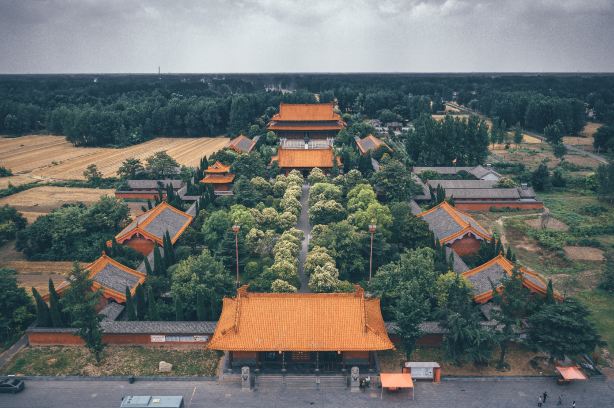
Located in the northeast corner of Taiqing Palace Town, 5 kilometers east of Luyi County, Zhoukou City, it is the birthplace of Laozi and also a temple dedicated to Laozi. In 1997, archaeological experts excavated a large cultural relic group in Taiqing Palace, including Longshan culture sites, Western Zhou tombs, Eastern Zhou rammed earth foundations and large horse pits, Tang and Song architectural foundations, inscriptions and Ming and Qing architecture. The site is early in age, large in span, well preserved, rich in cultural connotations, and has high value. The main attractions include Jiubujing, Taiji Hall, Sanshengmu Hall, Wangyuejing, and Sun and Moon Pool. Taiji Hall: A mixed building constructed with building materials from different periods of Han, Tang, Song, Ming and Qing dynasties. The Sanshengmu Hall in the harem: There are constant fireworks all year round, and it is very prosperous. It is said that during its heyday, when Wu Zetian of the Tang Dynasty proclaimed herself emperor, it was named Tianhou Hall. Moon-Watching Well: On the 15th day of the eighth lunar month every year, when the wind is clear and the moon is full, the bright moon in the sky is projected in the center of the well, which corresponds to the ancient poem "The moon in the sky is the moon in the water". Another unique feature of this well is that when ancient coins are thrown into the well, the coins will make a sound similar to the croaking of frogs at the moment of falling into the water, so people throw coins to listen to the frogs for fun when they have nothing to do. When later generations cleaned this well, they dug out many rusty ancient coins. But today's coins don't make any sound. Sun and Moon Pond: Enter Taiqing Palace and walk a short distance along the sacred road, you can see the Sun and Moon Pond. Legend has it that when Laozi was born and became an immortal, the sky was full of rosy clouds, and the sun and the moon appeared at the same time. Even more coincidentally, on September 24, 2006, at the foundation laying ceremony of the Taiji Hall donated by Feiyan Cave to Laozi's hometown, the wonders of the sun and the moon shining together and the three clouds gathering appeared again. Tang and Song Dynasty Stele: There is a Song Dynasty stele: more than 3 meters high, with only a small part of it exposed above the ground. Going back, you can see another Tang Dynasty stele, which is almost entirely underground. The preface was written by the emperor of the Tang Dynasty, and the front of the stele is in the official script of the Tao Te Ching. Although it is severely eroded by wind and rain, it still has the charm of the Tang Dynasty stele and has extremely high artistic value. Yuan Dynasty stele: This imperial edict stele is carved from bluestone, and the inscription is in regular script of the Yuan Dynasty: "The order orders envoys, soldiers and horses not to stay in the palace, and all trees planted by people are not allowed to be cut down."Luyi · 20.8 km from Bozhou
Experiences you can't miss in Bozhou
Featured Day tours in Bozhou
View all Day tours


Free things to do in Bozhou
Bozhou Museum
Bozhou · 721m from downtownBozhou Old Street
Bozhou · 3.9 km from downtown
Cao Cao Park
Bozhou · 953m from downtown
Zhuangzi Ancestral Hall
Mengcheng · 2.6 km from downtown
Buddhas Pagoda
Mengcheng · 521m from downtown
Mengcheng Museum
Mengcheng · 3.6 km from downtown
Song Du Huangcheng Cultural Tourism Resort
China · Kaifeng
Yimen Ancient Town
Guoyang · 20.9 km from downtown
Henan Museum
China · Zhengzhou
Sanhe Ancient Town
China · Feixi
What travelers say about Bozhou

悠悠水瓶座October 21, 2026
4.0
The Cao Cao Underground Military Tunnel in Bozhou is hailed as the "Underground Great Wall." Stepping into the deep, blue-brick tunnels feels like traveling back to the Three Kingdoms period. The winding passages retain ancient military designs such as cat-ear tunnels and obstacle courses, allowing visitors to truly appreciate the military wisdom of the ancients. Guided tours are available via QR code, creating a rich historical atmosphere. Some passages are low, requiring visitors to bend over and walk slowly; older visitors should be especially careful. It's definitely worth a visit for those interested in the history of the Three Kingdoms. However, it feels overly commercialized, with too many souvenir shops.
Cao Cao Underground Tunnel for Transporting Troops

国泰明壮October 8, 2026
5.0
It has a rich historical background and is relatively small; you can see everything in about two hours. Go check it out! Everyone has different tastes, so you're sure to find something you like. Preserving the historical site and leaving a trace of history is the most important thing.
Huaxilou

sumnAugust 6, 2020
5.0
Bozhou is worth visiting again. It borders Henan Shangqiu, Anhui Fuyang, Huainan and Bengbu. It has a long history and is also the world's largest distribution center for Chinese medicinal materials. The beef noodles and mutton soup are delicious.
Bozhou Ancient City

petitedragonFebruary 22, 2026
4.0
Huazu Nunnery, also known as Huazu Temple, was first built in 904 AD during the Tang Dynasty to commemorate Hua Tuo, a renowned physician of the Eastern Han Dynasty.
Because the temple was consistently headed by female monks, it was called a nunnery.
Online ticket purchase is very convenient, and free parking is available.
Huazu Temple

五行缺土26May 4, 2026
4.0
The Nanjing Lane Money Exchange in Bozhou is well worth a visit, as it's a well-preserved Qing Dynasty building. The three-courtyard complex features blue bricks and gray tiles, a well-organized layout, and the charm of Hui-style architecture. Visitors can see ancient counters, accounting rooms, and secret poems; the ingeniously designed underground vault showcases the financial wisdom of the past. It offers an immersive experience of the bustling commercial port of the Ming and Qing dynasties, and provides insights into the history of ancient coins and money exchanges – a truly excellent experience. However, the ticket price is slightly expensive, making it only moderately cost-effective.
Nanjing Alley Qianzhuang

海畔望云山December 2, 2025
5.0
Perhaps due to its somewhat remote location and the wrong season, it was quite deserted, but it was actually very well-built, spacious, and the restrooms were clean. Even with almost no one around, there were still performances, the actors were very dedicated, and there were plenty of trendy new elements throughout. A full-price ticket of 30 RMB is definitely worth it.
Huatuo Baicao Garden

M52***87April 22, 2026
5.0
An old steed in its stall may still aspire to gallop a thousand miles; a hero in his twilight years may still cherish his lofty ambitions.
Perhaps because this year is the Year of the Horse, the central piece in the Cao family cemetery inscription brick exhibition hall at the Bozhou Museum is a portrait brick with a horse design.
(It doesn't have the inscription "Even if I die, I will fight" [Facepalm][Facepalm][Facepalm] Not even a replica...)
However, there are other exquisite inscription bricks! It was quite moving to see.
Some of the brick carvings have a calligraphic feel,
while others are more casual (sloppy...).
Perhaps they were carved by craftsmen, perhaps by officials.
The sentiments of 1800 years ago are carved on bricks, used to build tombs, and buried deep underground.
There's "当奈何" (It really gave me a jolt! From "虞兮虞兮奈若何" to "为之奈何," I wonder what the person who carved it felt like.)
There's "顷不相见" (Having not seen each other for a long time, or perhaps never to see each other again...?)
There's "为曹侯作壁" (Building a wall for Lord Cao).
There's "异异" (Is it "Too strange," or someone's nickname? But it certainly is...) (Rarely do personal names appear)
When the word "literature" appears (referring to the Three Caos and Seven Scholars, the Jian'an literature, and Cao Pi's writing: "Literature is a great undertaking for governing the country, an immortal achievement. Life has its end, and glory and pleasure cease with one's own life; these are inevitable, but literature is boundless."), why would the craftsmen who built the tomb inscribe "literature" on the bricks?
When the word "sorrow" appears (referring to Cao Cao's poem: "Sorrow arises from within, and cannot be stopped," and Cao Pi's writing: "High mountains have cliffs, forests have branches. Sorrow comes without direction, and no one knows it. Life is like a sojourn; why have so many sorrows? If I am not happy now, the years will fly by."), who inscribed his sorrow on the tomb bricks?
Han dynasty clerical script truly becomes more beautiful the more you look at it!
Bozhou Museum

wbclawyerApril 15, 2021
4.0
Bozhou Old Street is near Huaxiluo Square. The whole old street is not very long and it takes about an hour to walk around it slowly. There are mainly antique buildings on both sides. Most of the shops along the street sell various delicacies, snacks, cultural relics and antiques, etc. It is a good place to stroll around if you like. The ancient street is open to the public for free.
Bozhou Old Street

慢步地球July 31, 2026
5.0
My first time visiting Bozhou, and I was so lucky to see the newly released large-scale historical drama "Cao Cao" on July 10th in Cao Cao's hometown! The entire performance brilliantly portrayed important historical moments in Cao Cao's life and is definitely worth experiencing! It starts at 8 pm and consists of four chapters, with a total performance time of 70 minutes. The script was written by Yi Zhongtian.
Cao Cao Live Epic Show

Sherry10124July 11, 2026
5.0
Taiqing Palace is definitely worth it. It's antique and has a quiet atmosphere, perfect for calming the mind. The architecture is very charming and makes for great photos. The staff are also very friendly and provide detailed explanations. Walking around alone was incredibly relaxing. I'd definitely come back again.
Taiqing Palace


