Things to do in Xing County
Explore top experiences
Top 10 attractions in Xing County


Yungang Grottoes
Yungang Grottoes Scenic Area is divided into a landscape zone and the grottoes. It is one of the three largest grottoes in China. The sculpture combines Chinese and Western art. Here you can experience the artistic charms of Northern Wei Dynasty. Yungang Grottoes not only embodies traditional Chinese art style but also integrates art styles of ethnic groups from ancient India, countries west of China and China's central plains. It is a famous historical site in Datong City.China · Datong

Jinci Temple Museum
Jinci Temple is located on the banks of the Jin River at the foot of Xuanweng Mountain, 25 km southwest of Taiyuan. It was built by later generations to commemorate Tang Shuyu, the founding feudal lord of the Jin State, and served as the ancestral temple of the Jin State. It is often said that "a visit to Taiyuan is incomplete without seeingJinci Templethe saying "a wasted trip to Taiyuan". After getting off at Jinci Temple, the first place you'll reach isJinci MuseumThis is a free park with a pleasant environment, perfect for casual strolling. After about a 10-minute walk through the park, you'll reach the main area of Jinci. Inside Jinci Museum,Jinci TempleThe "Three Treasures" (Xian Hall, Flying Bridge Across Fish Pond, and Shengmu Hall) and "Three Wonders" (Zhou-bai, Nanlao Spring Pavilion, and painted clay sculptures) are must-sees for every visitor toJinci Templeview that everyone must see. Jinci TempleThe "Three Treasures" are connected and located atJinci Templeon the central axis, allowing for a combined visit. Xian Hall is a place for offering sacrifices, with fence-like walls on all four sides, providing good ventilation and coolness. Notably, not a single iron nail was used in the beams and pillars throughout the hall. The Flying Bridge Across Fish Pond is located in front of Xian Hall and was built during the Song Dynasty. The entire view resembles a modern overpass, making it the only existing example among ancient bridges in China. One end of the "Flying Bridge" connects to Shengmu Hall, which is the earliest existing main building in Jinci Museum. The main hall is spacious, and a major highlight is its beam-and-pillar structure without internal columns. Eight wooden carved coiled dragons, appearing ready to fly, are carved on the eight corridor pillars in front of the hall, which, together with the "Flying Bridge Across Fish Pond," present a magnificent sight. Centered around the Hall of the Holy Mother, it's easy to find the "Three Wonders." The painted clay figurines are located inside the Hall of the Holy Mother, with the main statue of the Holy Mother seated majestically in a wooden shrine, dignified and resplendent, while the other 42 attendant statues stand on either side. These figurines are dressed in vibrant colors with varied expressions, including one maidservant dressed as a flower-dan (young female role in Chinese opera), her face half joyful and half sorrowful, evoking complex emotions in viewers. Master Mei Lanfang once stood before this maidservant statue for a long time, carefully studying her posture and inner emotions, and praised it highly. The Zhou Cypress, located north of the Hall of the Holy Mother, was planted during the Western Zhou Dynasty and is over 3,000 years old. The Pavilion of the Never-Aging Spring stands south of the Hall of the Holy Mother, where the source of the Jin River flows continuously year-round. In addition,Jinci TempleInside, there is also the extremely precious "Jinci Inscription" stele, personally composed and handwritten by Emperor Taizong of Tang, Li Shimin. At the southernmost part, you can find the Shifang Fengsheng Zen Temple, which is said to have originally been the villa of Yuchi Gong, a founding general of the Tang Dynasty. In the northern part of the temple complex, the Futu Courtyard houses the Sheli Shengsheng Pagoda. Climbing the pagoda offers a panoramic view.Jinci TempleThe panoramic view is clearly visible.China · Taiyuan
Yingxian Wooden Pagoda
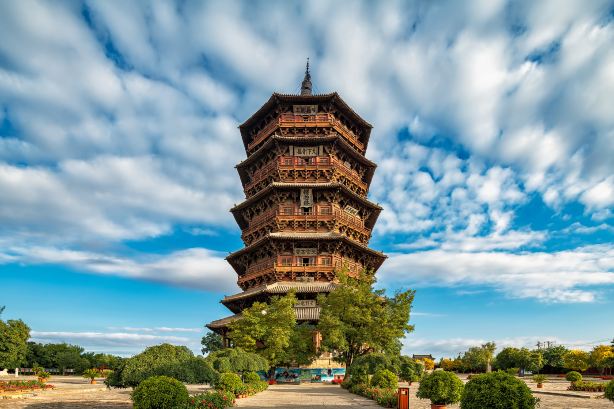
The full name of Yingxian Wooden Tower is Sakyamuni Pagoda of Fogong Temple. It is in the Fogong Temple in the northwest of Yingxian County. The octagonal wooden pagoda has five stories. Except for the high-end stone foundation of the first floor, the rest of the pagoda is made of wood using the traditional craftsmanship of Sunmao. Each layer of the wooden tower is equipped with wind chimes for a pleasant sound when the wind blows.China · Ying County

The Hukou Waterfall Scenic Area
The Hukou Waterfall is a famous waterfall on the Yellow River. The roiling water of the Yellow River roars downward here with great power. The Hukou Waterfall area is divided by the Yellow River. On the west side is Yichuan County, Shaanxi, and on the east side is Ji County, Shanxi. The waterfall is also divided into the Hukou Waterfall (the part of the falls in Shaanxi) and the Shanxi Hukou Waterfall (the part of the falls in Shanxi). Separate tickets are sold for each area. The Shanxi section of the Hukou Waterfall is located 45 kilometers west of the seat of Ji County in Linfen City, Shanxi.China · Ji County

Pingyao Ancient City
Pingyao Ancient City is approx. 85 km from Taiyuan. The streets, shops, and residences within the ancient city still maintain their traditional layout and appearance, making it one of the best-preserved ancient cities in China. It is also the only ancient county town in China that has successfully been listed as a UNESCO World Heritage Site as an entire city. Pingyao was once the financial center of China during the late Qing Dynasty. Walking through this once-prosperous ancient city, you can feel the essence of Shanxi merchant culture everywhere. The ancient city has six gates in total, with the north gate near Pingyao bus station and the west gate nearPingyao train stationThe south gate and west gate are places with many travelers. Entering the ancient town does not require an admission ticket, but if you want to climb the city wall or visit attractions like the ticket number, you need to purchase a pass for the ancient town. The ancient town is not very large, and walking is enough to explore it all. If you prefer not to walk, you can also take electric bikes. The streets of the entire ancient city are laid out in the shape of the Chinese character "土" (earth). When visiting, you usually enter the city from the West Gate and walk along West Street to Rishengchang Draft Bank, known as the "ancestor of modern Chinese banking". Here you can not only learn about the development history of ancient banking, but also have the old manager in a long robe and mandarin jacket write a draft for you using the early draft method, which is particularly historical. Moving forward is the north-south spanningSouth street, it is the central axis of the ancient city. During the Ming and Qing dynasties,South streetControlling over half of the nation's financial institutions, it was hailed as the "Wall Street of China" in its heyday. Today, it remains a bustling area of the ancient city, known as the Ming-Qing Ancient Street. Most attractions in Pingyao Ancient City are concentrated here, centered around the landmark structure, the Ancient City Tower. Surrounding it are attractions like Xie Tong Qing ticket number (China Banking Museum) and Wei Tai Hou (Ticket number museumAttractions such as Baichuantong, China Escort Museum, Tongxinggong Escort, Weishengchang, China Rare Newspaper Exhibition Hall, and Tianjixiang are available, along with restaurants, musical instrument stores, cafes, and bars. After strolling along the street, you can dine here, buy some souvenirs, and then continue south for more sightseeing. At the Pingyao Ancient City's county government office on the south side of the ancient city, you can see a large number of ancient documents and torture instruments, with daily performances of court sessions; near the Shangdong Gate are the Pingyao Ancient City's Chenghuang Temple andConfucian templeIt is quite grand and meticulously built, with thriving incense offerings where you can burn joss sticks. The Pingyao Ancient City wall is also one of the highlights of the ancient city, being not only majestic but also remarkably well-preserved. Climbing the wall offers a panoramic view of the entire ancient city. Among the gates, the tower of the south gate (Yingxun Gate of Pingyao Ancient City wall) is exquisitely crafted, and this area is close to residential buildings, allowing visitors to observe the daily life of the locals. If time permits, you can walk around the ancient city along the wall to fully appreciate its charm, which takes about an hour. Watching the sunset from the wall in the evening presents a beautiful scene. Besides the ancient town itself, Pingyao has two other major attractions: Zhenguo Temple and Shuanglin Temple. Zhenguo Temple was built without a single nail, with all structures joined by interlocking wooden components. Shuanglin Temple houses over 10 halls containing exquisitely crafted painted sculptures dating from the Yuan to Ming dynasties. It is highly recommended to stay overnight in the ancient town to enjoy its night view. You can also rent a bicycle to explore the small alleys and experience the authentic Pingyao, where the local culture and customs or photography make excellent subjects. Especially during the Chinese New Year, Pingyao is full of festive atmosphere. The town features old courtyards converted into inns, which are usually affordable, with clean and tidy accommodations available for just a few dozen yuan. Additionally, Pingyao is renowned for its beef. In the late Qing Dynasty, Empress Dowager Cixi passed through Pingyao and was so fond of the local beef after tasting it that she designated it as a royal tribute. Shops bearing the name "Guanyun beef" can be seen everywhere in the ancient town, making it hard to distinguish authenticity, and prices are generally high. You may consider buying some outside the town to try or give as gifts to friends and relatives.China · Pingyao County

Xuankong Temple
Xuankong Temple is located between the cliffs of Cuiping Peak in Jinlong Gorge, Hengshan. It was built in the Northern Wei Dynasty and has a history stretching longer than 1,500 years. It is a well-preserved high-altitude wooden cliff building in China. At the foot of Hengshan, from a distance, you can see the Hanging Temple suspended over the mountainside. The entire temple is hung on the steep cliff, skillfully utilizing and building into the concave and convex portions of the cliff, making it exceptionally staggered and yet rhythmic. Visitors walk along the wooden plank road suspended within the temple to feel the magical architectural charm of the Hanging Temple.China · Hunyuan

Xing County Yellow River Liulangzhai Tourist Attraction
Xing County · 21.7 km from downtown

Dazhao Temple
Ih Juu Temple in downtown Hohhot was built in the 8th year of the Ming Emperor Wanli (1580) by Altan Khan, the leader of the Mongolian Tümed. The temple belongs to the Gelug (or Yellow) School of Tibetan Buddhism. Priceless cultural relics not to be missed on a visit to Ih Juu Temple include a silver statue of the Buddha Sakyamuni, the dragon columns and the colorful wall murals. The pure silver statue of the Buddha Sakyamuni in the temple's main hall weighs 1,500kg. Immediately in front of the Buddha Sakyamuni are two golden dragons entwined around the columns, aptly named the Dragon Columns. Because the murals were painted with mineral-based colors, the colors remain bright and vibrant even today. The murals' content is mostly classical stories from Buddhist scripture.China · Hohhot

Huayan Temple
Huayan Temple is located in the center of Datong. This temple was built in the 8th year of Liao Qingning Period (AD 1062). In the Daxiong Hall of Huayan Temple, you can see the groundworks of Liao Dynasty and the buildings of Jin Dynasty, as well as the statues of Ming Dynasty and the murals of Qing Dynasty. The Hall of BojiaJiaocang in the temple is the only Liao Dynasty building here. The statues from Liao Dynasty in the Hall are extremely precious. There is a double-storey pavilion-style cabinet behind the Hall of Bojiajiaocang, the upper level is for Buddha statues and Buddhist altars, and the lower layer stores for books.China · Datong

Hukou Waterfall tourist area of the Yellow River
The Hukou Waterfall tourist area of the Yellow River is located on the riverbed of the Yellow River in the Qin-Jin Grand Canyon, where the provinces of Shanxi and Shaanxi face each other across the river. The main stream of the Yellow River, originally hundreds of m wide, suddenly narrows to dozens of m and plunges into a deep trough with a drop of 20–30 m, resembling water being poured from a giant pot—hence the name "Hukou" (Pot Mouth). Due to the large amount of sediment carried by the river, the waterfall presents a rare golden-yellow view: the turbid waves roar down with a sound like distant thunder rolling through the valley, while the rising mist lingers before the cliff, earning the nickname "smoke rising from the water." On sunny days, sunlight casts a rainbow over the waterfall, known as "a rainbow playing in the water." The mist may drench visitors even without wind or rain, creating the wonder called "rainfall under a clear sky." Hukou waterfall is regarded as the symbol of the "soul of the Yellow River" and the spirit of the Chinese nation. In 1938, when poet Guang Weiran crossed the Yellow River, he witnessed the roaring waves of Hukou and the boatmen's chants, which inspired him to create the now-legendary Yellow River Cantata. Liang Heng's essay of the same name was selected for middle school Chinese textbooks, and the back of the fourth series CNY 50 banknote also features this scene. Many first learned about it through textbooks and currency before visiting in person. In the past, cargo ships had to leave the water and bypass the waterfall here, leaving behind the maritime memory of "sailing on dry land." The scenery here varies with the seasons: In early spring, the upstream ice melts and the water level rises sharply, coinciding with the blooming of mountain peach blossoms on both banks, known as the "March peach blossom flood." In midsummer, the rainy season brings abundant water, with muddy waves towering into the sky. After fall begins, the rainy season subsides, and the water becomes high and steady. As the fall breeze sweeps by, rainbows often appear, earning the name "Hukou autumn breeze." In deep winter, layers of ice form along the banks, and overflow freezes into inverted ice peaks, glistening under the sunlight, creating the spectacular "upside-down ice peaks." The viewing platform on the Shaanxi side stretches along the cliff top on the western bank, offering a commanding view of the "thousand-mile Yellow River funneled into one pot" and the ten-mile-long Dragon Trough below the waterfall. During high-water seasons, the mist is heavy, and clothes get soaked quickly, so remember to protect your camera and phone; the boardwalk is slippery, so watch your step while walking and taking photos.China · Yichuan
Experiences you can't miss in Xing County
Featured Travel photography in Xing County
View all Travel photography

Instant confirmation
Book now for today
FromMXN6,212.54

Instant confirmation
Book now for today
FromMXN6,212.54

FromMXN310.63

FromMXN3,106.27

Instant confirmation
Book now for today
FromMXN3,106.27

FromMXN3,727.52
Free things to do in Xing County


What travelers say about Xing County

诗伶October 24, 2026
5.0
The Yungang Grottoes truly deserve their status as a World Heritage Site, boasting a grand scale and magnificent sculptures. The five caves of Tan Yao are the essence of the site, with the large Buddha statues exuding solemnity and exquisite carving techniques. The scenic area has a clear route and well-equipped facilities. A guided tour is essential; otherwise, you'll only see the surface and won't fully appreciate the historical value of the stone carvings. It's recommended to visit early to avoid crowds and enjoy better lighting.
Yungang Grottoes

WilsonOctober 24, 2026
4.0
One of the must-see attractions in Taiyuan!
The Jinci Museum is definitely worth a visit. The artifacts on the ground offer a glimpse into Shanxi, truly a glimpse into a thousand years of history. You can also take photos similar to those in Journey to the West.
The Jinci Park outside the museum is also worth exploring. Although it's newly built, the vegetation coverage is excellent, with flowing water and a lovely environment.
Jinci Temple Museum

Anonymous userOctober 21, 2026
5.0
Buying on the go is very convenient.
I'd been wanting to see the wooden pagoda for a long time, and this visit was truly breathtaking. The entire scenic area revolves around the wooden pagoda; you can enter from the first floor, and even then, it took almost two hours to see it.
Yingxian Wooden Pagoda

陈呱呱🍭October 22, 2026
5.0
I only went to the Shanxi entrance; I don't know if I can enter through the Shaanxi entrance. Seeing the Yellow River, the Mother River, was still very impressive; seeing it in person is definitely a great experience. There were also performances.
The Hukou Waterfall Scenic Area

Kimberly NolanOctober 23, 2026
5.0
We came to Pingyao as a stop off on the way to Xi’an from Beijing. We didn’t book a guide, just thought we’d explore and that turned out to be perfect for us. We spent one full day exploring the streets, attractions, the wall and the many shops and restaurants. We also caught the evening light show which was a highlight. A great day and well worth the visit.
Pingyao Ancient City

Elody NguyenOctober 22, 2026
5.0
Thật sự là mình đã nhầm lối đi lên chùa treo khi quay lại xếp hàng rất dài và chờ rất lâu. Ở Trung Quốc mọi thứ đều xếp hàng dài, nhưng chùa treo giới hạn lượt leo nên các bạn nên dành thời gian ở đây ít nhất 6 tiếng. Tránh xếp lịch dày
Xuankong Temple

_We***68October 19, 2026
5.0
Dazhao Temple and Xilitu Temple have many similarities. You can see some people taking commercial photos, and there are many exquisite Tibetan Buddhist statues and halls. There are also some halls on both sides. For those who are not familiar with it, it is good to learn about Tibetan Buddhism. But don't have too high expectations.
Dazhao Temple

旺仔小王子ooOctober 19, 2026
5.0
It's beautiful! The painted decorations in Shanxi are truly unique; it feels like you're surrounded by immortals. Huayan Temple has the largest existing chiwen (mythical beast ornament), and the all-copper underground palace is also astonishing. Definitely worth a visit!
Huayan Temple
Anonymous userOctober 20, 2026
5.0
A Family Review of Hukou Waterfall (100 words)
Visiting Hukou Waterfall with friends is definitely worthwhile! The Yellow River rushes down with tremendous force, its roar audible from afar. Standing on the viewing platform, experiencing the Mother River is truly magnificent. The path is relatively smooth, making it easy for seniors to view. However, the water mist is heavy, and the wind can easily get your clothes wet, so remember to bring a jacket.
You need to take the scenic shuttle bus.
Hukou Waterfall tourist area of the Yellow River


