Sheqi

Things to do in Sheqi

Search attractions or local attractions & tours
Search

Explore top experiences

Top 10 attractions in Sheqi

View all Attractions
Shedian Ancient Town
No. 4 of Fall Viewing Attractions in Nanyang

Shedian Ancient Town

4.7
4.9/5
971 reviews
The ancient city of Shengdian is located in Shengdian Town, Sheqi County, Nanyang City. The ancient city was built in the Eastern Han Dynasty and flourished in the Ming Dynasty. It has a history of more than 1900 years. Today, the ancient city of Credit Store is a well-preserved ancient city, where there are city walls, wharfs, streets, shops, and residential buildings from the Ming and Qing Dynasties. Surrounded by a 5-kilometer-long city wall around the ancient city, the ancient city is far from the hustle and bustle of big cities, and there are quaint streets everywhere. Until now, the taste of human development is not very strong. Tourists can follow the route of Sheqi Shanxia Guild Hall-Guangsheng Security Bureau-Lijin Bureau-Weisheng Long Ticket Number-Jian Guild Hall-Huoshen Temple. These attractions are located near Yongqing Street and Old Street, not far from each other. In addition, there are also attractions such as the Porcelain Museum and the Jiang Family Courtyard in the ancient city. Among the many scenic spots in the ancient city, Shanshan Guild Hall is one of the most important ones. The Guild Hall was built in the 21st year of Emperor Qianlong's reign in the Qing Dynasty (1756). The buildings located on the central axis are: Glazed Wall, Xuanjian Building, Stone Arch, Dabai Hall, Chunqiu Building (destroyed in war). When visiting the hall, tourists can pay more attention to the decorative arts of the hall, such as wood carving, stone carving, brick carving, colored glass, colored painting, palace lanterns, etc. Among them, the carvings and other crafts are very delicate. Under the background of lights, the ancient buildings such as Shanshan Guild Hall are more dazzling and gorgeous. You can take a walk along the Zhao River near the ancient city, and visit Hongqi Road and Cultural Square.Sheqi · 257m from downtown
Sheqi's Shanxi-Shaanxi Guild Hall

Sheqi's Shanxi-Shaanxi Guild Hall

4.7
4.9/5
817 reviews
Located in Sheqi County, Nanyang, Shanxi and Shaanxi Guild Hall was first built in the 21st year of Emperor Qianlong's reign (1756) in the Qing Dynasty. It was completed in the 18th year of Emperor Guangxu's reign (1892) and lasted for 136 years under six emperors. The Guild Hall was built by merchants from Shanxi and Shaanxi provinces who lived here at that time. Because Guan Gong was worshipped in the hall, it was also called Guan Gong Temple and Shanxi and Shaanxi Temple. It is an ancient building complex that combines commercial guild halls with Guandi Temple buildings. It was built at the time of the last climax in the history of ancient Chinese architecture. The Guild Hall faces north and south, covers an area of ​​about 7,750 square meters, and the ground is paved with blue-white stone slabs one foot square. There are more than 130 existing halls, halls, towers, pavilions and various buildings. The main building consists of four parts: the large glazed screen wall, the Xuanjian Tower, the Great Worship Hall, and the Spring and Autumn Tower, which are distributed in a central axis from south to north. In front are the glazed screen wall, iron flagpole, east and west gates and east and west stables; behind are the Xuanjian Tower, bell and drum tower, east and west corridors; behind are the Great Worship Hall, Medicine King Hall and Horse King Hall; and behind is the Spring and Autumn Tower. Sheqi Shanxi Guild Hall is a private chamber of commerce building among the national guild halls that has received the imperial calligraphy of Empress Dowager Cixi, and is recognized by industry experts as an "outstanding guild hall". The two mountains in front of the eaves of the main hall of the guild hall are embedded with the two-character tablets "Dragon" and "Tiger" of the imperial calligraphy of Empress Dowager Cixi. The tablet is 0.42 meters wide and 0.80 meters high, with a round top and a square bottom. On the top is a square seal with the nine characters "Empress Dowager Cixi's Imperial Brush Treasure". The left forehead is also inscribed with the nine characters "Empress Dowager Cixi's Imperial Brush Treasure", and the two characters "Dragon" and "Tiger" in cursive script are engraved in the middle, which are written in one stroke. The font is elegant and strong, and it runs through in one breath.Sheqi · 236m from downtown
Longmen Grottoes
2026 Asia 100 - Best Things to Do

Longmen Grottoes

8.9
4.7/5
62.2k reviews
Longmen Grottoes are located in the southern suburbs of Luoyang, Henan Province, on the cliffs along both banks of the Yi River. As one of China's three major grotto art treasures, they were inscribed on the World Cultural Heritage list in 2000. The grottoes were first carved when Emperor Xiaowen of Northern Wei moved the capital to Luoyang, and construction continued through the Eastern Wei, Western Wei, Northern Qi, Sui, and Tang dynasties, with the vast majority of niches and statues left from the Northern Wei and Tang periods. Today, more than 2,000 niches and over 100,000 statues remain, along with a large number of inscriptions and steles, making the site an important representative of Chinese stone carving art. The attraction is divided by the Yi River into two parts: West Hill and East Hill. The West Hill Grottoes are the essence of the site, carved from the Northern Dynasties through the Sui and Tang periods. Famous caves include Guyang Cave, Binyang Cave, Lotus Cave, Wanfo Cave, and Fengxian Temple. The Lushena Buddha at Fengxian Temple stands about 17 m tall, making it one of the larger Buddha statues at Longmen Grottoes. Its face is dignified and serene, with a faint smile, and legend holds that it was modeled on the appearance of Wu Zetian, earning it the name "Oriental Mona Lisa." The inner walls of Wanfo Cave are densely covered with about 15,000 small Buddha statues, each only a few cm tall, neatly arranged and finely crafted. Guyang Cave is the earliest cave carved at Longmen, and its inscription calligraphy is exquisite; the selected "Twenty Masterpieces of Longmen" are representative works of Wei stele calligraphy. Binyang Cave consists of the South, Middle, and North caves and took more than twenty years to complete. Its original reliefs depicting emperors and empresses worshipping the Buddha were looted and lost overseas in the 1930s. In Binyang North Cave, a Buddha statue has a distinctive hand gesture, with the right index and middle fingers raised in a shape resembling the modern "scissors hand," though it is actually a Buddhist mudra, and it once sparked heated discussion online. The East Hill Grottoes are mostly Tang dynasty works and are smaller in scale than those on West Hill, but from the opposite bank visitors can enjoy panoramic views of West Hill from different angles, especially distant views of the Lushena Buddha. The attraction also includes Xiangshan Temple and Bai Juyi Memorial Park (Bai Garden). The Tang dynasty poet Bai Juyi lived in Luoyang in his later years and once praised it, saying, "Of the scenic splendors of Luoyang's surrounding mountains and waters, Longmen ranks first." When visiting, simply follow the route West Hill—East Hill—Xiangshan Temple—Bai Garden, proceeding in one direction without backtracking. The West Hill Grottoes are densely packed with content, so it is advisable to set aside ample time for a closer look; East Hill is quieter and more secluded, suitable for a brief visit and gazing across the river when energy is limited.China · Luoyang
Millennium City Park
2026 Asia 100 - Night Attractions

Millennium City Park

8.8
4.6/5
29k reviews
Qingming Riverside Landscape Garden, located on the shore of Longting Lake in Kaifeng, is a large-scale historical and cultural theme park that recreates the famous Song Dynasty painting "Along the River During the Qingming Festival" by the Song Dynasty painter Zhang Zeduan at a 1:1 scale. The park is divided into two sections by the Shuangting Bridge: the South Garden recreates the bustling city life of Bianjing (Kaifeng), with restaurants, teahouses, and pharmacies lining the streets; the North Garden is a royal garden, with palaces and courtyards standing by the lake. Many performers and vendors along the streets are dressed in Song Dynasty costumes, and the sounds of ancient music and drums create an atmosphere that easily evokes the feeling of "stepping into a painting and traveling back a thousand years in a single day." Architecture is the most visually appealing feature here: the Rainbow Bridge spanning the Bian River is a replica of the famous bridge in the painting, shaped like a rainbow, and standing on the bridge to watch the canal boats come and go is just like in the painting; the Fuyun Pavilion stands tall above the other pavilions in the garden, with its red floors and golden tiles on four eaves, giving one the feeling of climbing up from afar; the Shangshan Gate is a reconstruction based on the gate of the Northern Song Dynasty's Bianjing city, tall and majestic, with brilliant paintings, and is the most magnificent city gate in the garden; pavilions and waterside pavilions such as the Shuixin Pavilion, Shuangting Bridge, and Jiulong Bridge are scattered among the blue waves. The daytime highlight is the themed performances scattered throughout the park: "Bao Gong Inspects the Bianhe Canal" takes place on the water on both sides of the Rainbow Bridge; "Wang Yuanwai Seeks a Son-in-Law" features a ball being thrown from an embroidered tower in front of Wang Yuanwai's house to choose a husband; and "Yue Fei Spears Xiao Liang Wang" takes place on the Song Dynasty military training ground, with horses kicking up dust. Folk performances such as cockfighting, stilt walking, and drumming are interspersed throughout. For those who want to immerse themselves in the drama, they can go to the Sifangyuan to change into ancient costumes and enter the examination cells to experience the imperial examination of the Song Dynasty. Families with children can enjoy rides such as carousels and roller coasters at the Song Dynasty Royal Park, all wrapped in Song Dynasty stories. In the entertainment districts, various Song Dynasty performances such as face-changing, fire-breathing, and ancient magic tricks take place in turn, and intangible cultural heritage performances may happen around you at any time. The park takes on a different look after nightfall: large red lanterns light up one after another, and the streets are brightly lit, a stark contrast to the daytime scene. The large-scale water-based live performance "A Dream of Splendor in the Northern Song Dynasty" is staged on Jinglong Lake. The entire performance is linked by eight classic Song Dynasty poems and a painting of "Along the River During the Qingming Festival," transporting the audience back to Bianjing (Kaifeng) in the Northern Song Dynasty a thousand years ago. The performance lasts about 70 minutes, and many visitors specifically set aside time for the evening to see this show. Dining options are also convenient within the park: the snack street in Tokyo Food Street offers a variety of Kaifeng snacks such as stir-fried mung bean jelly, braised chicken, and almond tea, perfect for strolling and eating; if you want to sit down and have a proper meal, you can visit the reconstructed Sun Yang Restaurant in the park, which was originally one of the seventy-two restaurants in Bianjing during the Northern Song Dynasty, where you can taste traditional Henan dishes such as soup dumplings and braised carp noodles.China · Kaifeng
Laojun Mountain Scenic Spot
No. 1 of Fall Viewing Attractions in Henan

Laojun Mountain Scenic Spot

8.6
4.7/5
16.6k reviews
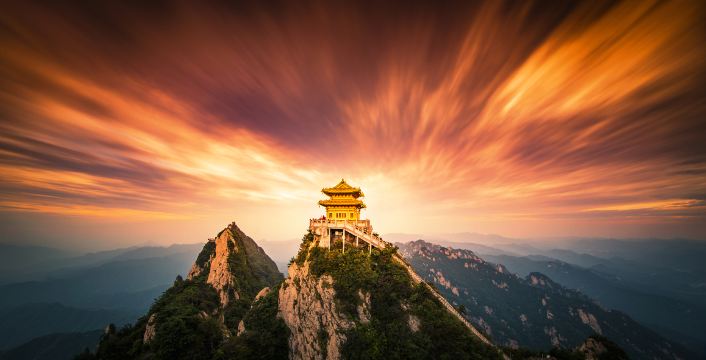
It is said that Laojun Attraction is the place where Li Er (Laozi), the founder of Taoism, practiced in seclusion. During the Northern Wei Dynasty, a temple was built in the mountain to commemorate it. Later, it was named "the famous mountain in the world" and has always been popular. The mountain is lush with trees and picturesque, and mountain springs can be seen everywhere. In the golden autumn, this is the best choice for viewing red leaves in the Souvenir areas. After the rain, Laojun Mountain is surrounded by clouds and mist in each peak, like a fairyland in the sky. The Attraction area is huge and is mainly divided into the main Laojun Mountain Attraction in the center, the Dream Valley Attraction in the west, and the Zhaigou Attraction Area in the east. Generally, tourists will spend a day to visit the main Laojun Mountain Attraction, which is also the most developed area of ​​the entire Attraction. If you go to the top of the mountain, you will also have the opportunity to see the beautiful sea of ​​clouds, sunrise, and sunset. The main Attraction of ​​Laojun Mountain includes Zhongtianmen, Jinding, Laojun Temple, Nantianmen, Yuhuangding and Mazongling. Since its construction in the Northern Wei Dynasty, Laojun Temple has been the center of worship for pilgrims from the Central Plains; the Taoist temple on Yuhuangding enshrines the Jade Emperor and is also a good place to view the scenery in the mountain; Jinding and Mazongling are good places to watch the sunrise and the sea of ​​clouds. Recommended itinerary: Day Trips Most tourists choose to spend a day to visit the main Attraction of ​​Laojun Mountain. Lingguan Hall - the statue of Laojun at the foot of the mountain - Lincu Hall - Zhongtianmen - tree-lined trail - Lying Yunsong - Bodhisattva Hall - Laojun Temple, Jinding - Yuhuangding, and then return along the original route. Tourists can choose to walk the whole way or take a "walk + cable car" tour of Laojun Mountain according to their own conditions. There is the Zhongling Cableway of the Attraction between the Lingguan Temple at the foot of the mountain and the Zhongtian Gate on the mountainside. Take the Zhongling Cableway and then walk from Zhongtian Gate to the top of the mountain, Yuhuang Peak. The road from Zhongtian Gate to the top of the mountain is not very steep and can usually be completed in about an hour. Two-day tour If you have enough time, you can spend two days to visit Laojun Mountain. The general route is: D1: Visit the main Attraction of ​​Laojun Mountain and stay in the mountain that night. D2: From the top of Laojun Mountain, choose to go down the mountain to the Dream Valley in the west or the Zhaigou Attraction in the east, and arrive at the west gate and east gate of the Attraction respectively. In the main Attraction of ​​Laojun Mountain, you can stay near Zhongtianmen on the mountainside and Laojun Temple on the top of the mountain. There are hotels near Zhongtianmen with better accommodation conditions, while the accommodation conditions Souvenir Laojun Temple are relatively poor. If you plan to go to the top of the mountain to watch the sunrise the next morning, you can stay Souvenir Laojun Temple. Compared with the Zhaigou Attraction in the east, the mountain roads in Dream Chasing Valley are smoother, and tourists can choose one of them to go down the mountain according to their preferences. There are many places in the Attraction that can provide Dining services for tourists, but the signboards on some sections of the road in the Attraction are not yet very complete, so tourists need to pay more attention when visiting.China · Luanchuan
Song Du Huangcheng Cultural Tourism Resort

Song Du Huangcheng Cultural Tourism Resort

8.6
4.6/5
177 reviews
Song Du Huangcheng Cultural Tourism Resort is located in the northern part of the old city of Kaifeng, precisely on the site of the imperial palace of the Northern Song Dynasty's Dongjing city. The millennium-old central axis of Kaifeng runs through this area, making it the core zone of the royal culture of the Song Dynasty. Here, you can find the Song-style imperial architecture of the Longting attraction, the tales of the Yang Family Generals at Tianbo Yang's residence, and the calligraphic steles of Han Yuan Stele Forest. The Shuanglong Lane historical and cultural block, 960 Cultural and Creative Park, and Qisheng Corner have transformed old streets and courtyards into Song-style blocks perfect for leisurely exploration. The resort also connects a series of Song culture attractions: Wansui Mountain Great Song Martial Arts City stages year-round martial arts live shows and intangible cultural heritage iron fireworks, while historic sites like the Iron Pagoda, Kaifeng city wall, Zhouqiao and Bian River ruins, Shanshangan Guild Hall, Yanqing Taoist Temple, and Fan Pagoda are scattered across the old city, along with niche spots like the underground wartime grain storage. These places are hard to cover in one day, so we recommend focusing on two or three key sites. After dark, a different experience awaits as the attractions light up in unison. Boarding a painted pleasure boat on the Great Song Imperial River to watch the illuminated pavilions and towers sway with the rippling water is a popular nightlife option here.China · Kaifeng
Wansuishan Martial Arts City
No. 1 of Family-friendly Attractions in Henan

Wansuishan Martial Arts City

8.6
4.6/5
16.6k reviews
Wansuishan Martial Arts City is located in the northwest of Kaifeng's urban areaWansuishan Martial Arts City, it is a large-scale attraction built with Song Dynasty culture and wuxia culture as its backdrop. Within the attraction, there are quaint and charming Song Dynasty garden streets and alleys, year-round exciting wuxia and period costume performances, as well as a wealth of entertainment facilities, making it a great place for relaxation and entertainment in Kaifeng, Zhengzhou, and surrounding areas. When visiting Wansuishan Martial Arts City, the first thing you will notice is the beautiful scenery of the attraction. Wansuishan Martial Arts City as a whole creates an atmosphere of the Song Dynasty, among which many views are very eye-catching, such as Wansui Temple, which recreates the splendor of a thousand-year-old ancient temple from the Song Dynasty, the Dragon Altar, which embodies the spirit of Buddhism, Confucianism, and Taoism, the relatively well-preserved ancient city wall of Kaifeng in China, and the "Nine Dragons Waterfall," one of the large man-made stream and waterfall groups in China. What is rare is that the attraction also has a very large area of forest and green space, with a quiet environment, and flowers bloom in season, making it very suitable for photography. Afterward, visitors will notice the unique wuxia features within the attraction. Year-round, multiple wuxia-themed performances are staged here, with several themed shows such as "Cross Slope," "Wu Song Drunkenly Beats Jiang the Gatekeeper," and "Wild Boar Forest" being quite spectacular—definitely not to be missed when visiting. Interactive performances like the "Wuxia Film and Television Experience Hall," "Martial Arts Champion," and "Li Kui Judges a Case" also allow visitors to participate in wuxia stories, offering plenty of fun. In the architectural design of the attraction, there are also many wuxia elements: the Wuxia Road built with large-scale weapons such as the "Heaven-Reliant Sword" and "Overlord Blade," the "Gallant Heroes Portrait" at the Great Song Martial Arts Hall, the "Sword Altar" at Cross Slope, Juxian Manor, and the Martial Arts Arena—all are uniquely distinctive. Additionally, every year during the Spring Festival periodWansuishanLarge-scale temple fairs are held, featuring grand performances, a rich variety of specialty snacks, a dazzling array of handicrafts, and highly distinctive entertainment activities, creating a lively atmosphere. It has now become one of the most popular temple fairs in the Central Plains region.China · Kaifeng
Sheqi Today's weatherFoggy 8-17℃
Sheqi weather for the next 2 days11/5: 9-20℃, 11/6: 9-21℃

Free things to do in Sheqi

What travelers say about Sheqi

user-avatar
疯子爱溜达July 23, 2026
5.0
The student package is such a great deal! The Shanxi-Shaanxi Guild Hall and the Fire God Temple are absolutely stunning. The carved beams and painted rafters, the brick and wood carvings, the glazed screen walls, the flagpoles and stone lions—every single one is a masterpiece, a treasure!

Shedian Ancient Town

user-avatar
水漫三楼April 11, 2026
5.0
The Sheqi Shanxi-Shaanxi Guild Hall, originally named the Shanxi-Shaanxi Fellow Townsmen Guild Hall, also known as the Shanxi-Shaanxi Temple and Guan Gong Temple, and formerly called Dingyuan Society, is located at No. 9 Yongqing Street, Shedian Town, Sheqi County, Nanyang City, Henan Province. Construction began in the 21st year of the Qianlong Emperor's reign (1756) and was completed during the reigns of the Jiaqing, Daoguang, Xianfeng, Tongzhi Emperors, and finally the 18th year of the Guangxu Emperor's reign (1892), spanning 137 years under six emperors. The main buildings of the Sheqi Shanxi-Shaanxi Guild Hall consist of a screen wall, a hanging mirror tower, a stone archway, a main worship hall, and a spring and autumn tower. More than 130 pavilions and towers remain, all paved with bluish-white marble both inside and out. The buildings are decorated with exquisite stone carvings, wood carvings, cast iron, and ceramic sculptures, exhibiting the grandeur of palaces and temples, the opulence of merchant guild halls, and the elegance of southern folk gardens. It is a typical example of Qing Dynasty folk architecture. In 1963, the Sheqi Shanxi-Shaanxi Guild Hall was listed as a provincial-level key cultural relics protection unit. On January 13, 1988, the Sheqi Shanxi-Shaanxi Guild Hall was designated as a third batch of National Key Cultural Relics Protection Units by the State Council of the People's Republic of China. The iron flagpole is 15 meters high and weighs over 50,000 jin (approximately 25,000 catties). It sits on a Sumeru pedestal made of bluestone, with carvings of celestial horses, qilin, lions, and other mythical beasts on its waist. An iron lion stands atop the pedestal, and the flagpole passes through the lion. The flagpole has three cloud-shaped brackets (large, medium, and small), each with four wind chimes. Dragons intertwine between the cloud-shaped brackets, and each is topped with a phoenix poised for flight. The glazed tile screen wall is a mysterious wall in Chinese courtyards, used to block wind, gather energy, and protect privacy. The screen wall of the Shanxi-Shaanxi Guild Hall is composed of 476 glazed tiles forming three separate scenes: "Double Dragons Playing with a Pearl," "Carp Leaping Over the Dragon Gate," "Qilin Fighting Beasts," and "Fishing, Woodcutting, Farming, and Reading." These scenes are ingeniously combined into a single, magnificent composition. The Grand Hall of Worship is the main building of the guild hall, consisting of a main hall and a worship hall. It is 40 meters long, 22 meters wide, and 23.14 meters high. Two stone carvings, each 2 meters high and 1 meter wide, with a single-eaved gable roof, stand on either side of the hall. The left side is inscribed with "Eighteen Scholars Ascending Yingzhou." The image depicts Du Ruhui, Fang Xuanling, Yu Zhiyu, and others braving hardships, riding horses along a rugged path to Yingzhou, a place admired by all.

Sheqi's Shanxi-Shaanxi Guild Hall

user-avatar
M85***00December 15, 2024
5.0
The first stop of our museum tour was the famous Palace Museum in my country. As soon as we stepped into the museum, it was as if we had traveled through time and space and arrived at the magnificent ancient dynasty. The architecture of the Palace Museum itself is a work of art, with red walls, yellow tiles, carved beams and painted buildings. Every detail reveals the majesty and style of the royal family.

Porcelain Museum

user-avatar
小胖鸡出门减肥November 3, 2026
5.0
The Longmen Grottoes are a very worthwhile site to visit. Unlike the relatively enclosed grottoes, the Longmen Grottoes offer a very direct and close-up view of the scenery inside and outside the grottoes, especially the Vairocana Buddha and its disciples, bodhisattvas, heavenly kings, and guardians. The close-up view is truly breathtaking!

Longmen Grottoes

user-avatar
_TT***33November 3, 2026
5.0
Wonderful theme park with lots of activities and performances

Millennium City Park

user-avatar
艳阳妮妮November 3, 2026
4.0
The location for the creative beer was illogical; it was impossible to get one, especially for those taking the tour bus up the mountain. I ended up buying another bottle. The most fun part was sliding down the mountain on my butt – a less strenuous activity and more interesting. The summit was absolutely stunning, but the order was terrible; nobody cared or looked after you. You had to shout to get down the mountain, otherwise you wouldn't be able to get down at all.

Laojun Mountain Scenic Spot

user-avatar
M55***20August 18, 2026
5.0
It's very worthwhile, but it's also very crowded, which might slightly detract from the overall experience. However, the people are incredibly welcoming, and there are many beautiful spots for taking photos. The food is also affordable and inexpensive, which kids enjoy. I'll definitely go back when it's less crowded.

Song Du Huangcheng Cultural Tourism Resort

user-avatar
M52***44November 3, 2026
4.0
The park is huge; I read online that it takes a whole day to explore it, and it truly is. The NPCs seemed only friendly to young people; they were rather indifferent to us 40+ year olds, probably thinking we wouldn't know how to enjoy ourselves. Prices within the park are very cheap, and we even saw Wang Po up close, which was quite interesting. The parking lot is a bit far from the park itself, but thankfully there's a free shuttle bus. It's very crowded, so those with children should be extra careful.

Wansuishan Martial Arts City

user-avatar
M37***13July 5, 2026
5.0
You need to go early; a thorough visit will take about three hours. It's best to research Zhuge Liang beforehand, as many rubbings require historical knowledge. There's also a Bagua (Eight Trigrams) maze to play in. The Wuhou Temple is ancient and charming; walking on the moss-covered steps, you can listen to the wisdom of the ancients. In our time, what we need is to calm our minds and read more.

Wuhou Temple In Wolonggang, Nanyang

Trip Moments in Sheqi

Popular cities near Sheqi

Frequently asked questions

How can I contact Trip.com customer support?

Get help anytime, anywhere within 30 secondsContact customer support

Change and cancellation policies vary by attractions and tours. Please check the product details page for more information.

Ticket prices may vary between weekdays and weekends, as well as during peak and off-peak seasons. When booking with Trip.com, you can also use Trip Coins to get extra savings. For more tips on booking discounted tickets, please visit Trip.com for the latest information.