Things to do in Poyang
Explore top experiences
Top 10 attractions in Poyang


Poyang Lake National Wetland Park
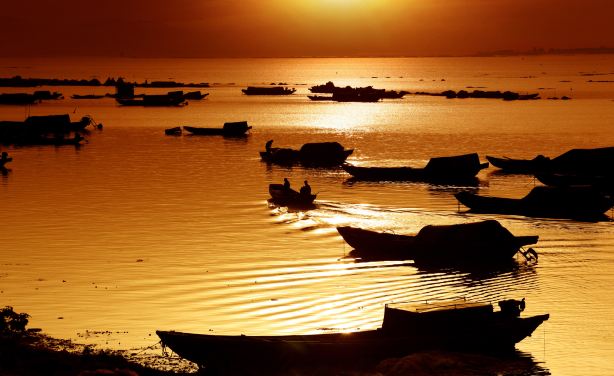
Poyang Lake National Wetland Park is a great place to see Poyang Lake, especially in the evening when it sparkles in the sunset. It is also a base camp for migratory birds, a gathering place for birds native to the wetlands. Visitors can see egrets in summer, along with swans, white cranes and oriental white cranes in the winter. The scenery here is gorgeous all year round, each season with its own distinct flavor. Attractions in the park are divided into the inner lake and outer lake. The inner lake includes such attractions as Dou Mountain, Longyan Mountain, Crane Park and Zhuxi Island. Visitors can take a boat tour to get a complete view of all of the scenic spots. Attractions in the outer lake include Xiangyou Fields, where visitors can enjoy views of pristine grasslands.Poyang · 13.2 km from downtown

Poyang Lake Grassland Scenic Area
Poyang Lake Prairie Scenic Area is located in Poyang County, Shangrao City, Jiangxi Province, China. It is a tourist destination famous for its magnificent natural landscape and rich ecological resources. This prairie not only showcases the natural beauty of the lake, but also provides a variety of outdoor activities and ecological experiences. The grassland attracts many tourists with its vast grasslands and rich biodiversity. Every spring and summer, the grassland is covered with green grass and wild flowers, forming a vibrant natural picture. Visitors can stroll on the grassland, enjoy the fresh air and tranquil environment, and feel the charm of nature. The ecosystem of Poyang Lake Prairie Scenic Area is complex and rich, and it is the habitat of many animals and plants. Especially in winter, thousands of migratory birds fly from the north and roost on the shores of Poyang Lake for the winter. There are multiple bird-watching platforms in the scenic area, where tourists can observe these beautiful birds up close and learn about their living habits under the guidance of professional guides. In addition to natural landscapes, Poyang Lake Prairie Scenic Area also provides a wealth of outdoor activities. Visitors can choose to ride horses, bikes or hike to explore different corners of the grassland.Poyang · 18.7 km from downtown

Raozhou Ancient Town
Raozhou Ancient Town is located in Poyang, Shangrao, Jiangxi Province, covering an area of 245 acres, and is the essence of Ganpo culture. The restored streets and alleys of the Ming and Qing Dynasties integrate cultural displays, folk performances, gourmet food and homestays, providing an immersive tourism experience.Poyang · 2.9 km from downtown

Wunian Island, Poyang Lake Prairie Scenic Area
The Poyang Lake Prairie Scenic Area is also known as Wunian Island. This is partly because "Wunian" originates from a Buddhist term, embodying a shift in perspective, and partly because Wunian Island's stunning natural scenery offers a sense of inner peace and inner calm. We hope everyone who visits Wunian Island will experience a sense of "no thoughts" while leaving the island. If Wunian Island is the essence of the Poyang Lake Prairie Scenic Area, then its hallmarks are arguably the "Eight Wunian Scenic Spots": Green Plains, Polygonum Flower Sea, Reed Maze, Birdsong, Sunset, Long Mountain Mist, Starry Sky Camp, and Leaving the Island. Poyang Lake in autumn and winter is a truly vibrant and beautiful time of year, making it a worthwhile experience for you to bring your loved one. You can elope to the beautiful Jiangnan prairie, where you can express your love amidst the poetic grasslands and the pristine waters. An unexpected encounter with migratory birds is a truly breathtaking experience.Poyang · 18.4 km from downtown

Taoyangli Historical and Cultural District
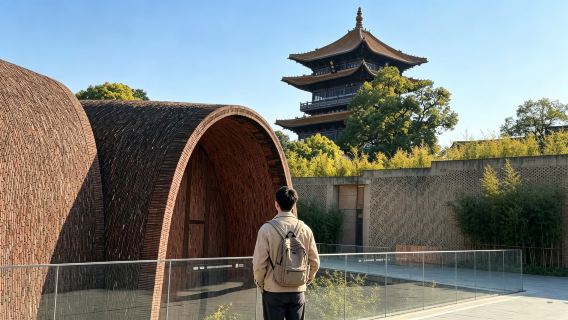
Taoyangli Historical and Cultural District is located in the heart of Jingdezhen's old town, a historic neighborhood that grew around the ruins of the imperial kiln from the Ming and Qing dynasties. The old saying "Taoyang thirteen li, with tens of thousands of households" refers to this area. The imperial porcelain used by the royal families of the Ming and Qing dynasties was exclusively produced by the imperial kiln here, while rejected tribute items were shattered and buried on-site. The layers of underground porcelain fragments share the same origin as the collections in the Palace Museum, making this place often referred to as the key to understanding the porcelain capital. The core attractions of the district are concentrated around the ruins of the Taoyangli Historical and Cultural District and the imperial kiln museum. The ruins of the Taoyangli Historical and Cultural District have now been transformed into an archaeological site park, preserving relics such as kilns and workshops. The Longzhu pavilion, perched atop Zhushan hill, has been the iconic structure of the imperial kiln since the Ming dynasty and later became the symbol of Jingdezhen. The Zhushan hill beneath it was formed by layers of discarded porcelain fragments from imperial kilns throughout history. Nearby, the imperial kiln museum draws inspiration from traditional egg-shaped wood-fired kilns, featuring multiple brick arches arranged in a staggered layout. Many exhibits in the museum are restored from porcelain fragments unearthed at the site, including the Ming dynasty blue-and-white dragon jar—a signature exhibit pieced together from tons of discarded dragon jar fragments. Adjacent to the museum, the Xu family kiln, an old wood-fired kiln, still operates periodic firings. During kiln openings, the gate is wide open, allowing visitors to watch artisans retrieve freshly fired porcelain from saggars. The district also features winding alleyways lined with kiln-brick residences, guild halls, porcelain shops, and remnants of modern ceramic industry. The restored South goods street and Red shop street now host old teahouses, taverns, music bars, and craft workshops where you can observe traditional processes like clay throwing and porcelain painting, with some workshops offering hands-on experiences. It's recommended to set aside half a day for the visit—start with the kiln site and museum, then meander through the streets around Zhongshan north road and Longgang lane, where many historic courtyard houses hidden in deep alleys await patient discovery.Jingdezhen · 58.5 km from Poyang

Jingdezhen China Ceramics Museum
The Jingdezhen Ceramics Museum is a large-scale ceramics special art museum. The contents of the exhibition are divided into “history department”, “new China department” and special exhibition hall. The Jingdezhen Ceramics Museum exhibits five generations of celadon, the Qing Dynasty white porcelain of the Song Dynasty, and the blue and white porcelain of the Ming Dynasty. Not only can you appreciate the fine porcelain, but you can also learn about porcelain. It is a good place for a relaxing holiday.Jingdezhen · 55.8 km from Poyang
Poyang Lake
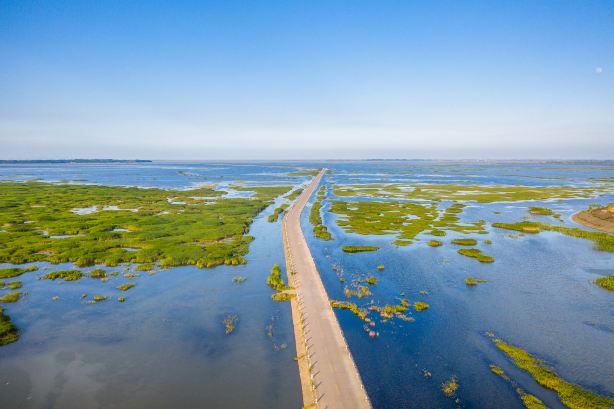
Poyang Lake is located in the northern part of Jiangxi Province, on the south bank of the Yangtze River. It receives water from five rivers—the Gan, Fu, Xin, Rao, and Xiu—and flows into the Yangtze River through Hukou, serving as the "catchment basin" for the Jiangxi water system and a "transfer station" for the five rivers entering the Yangtze. This body of water also carries a rich history; Zhu Yuanzhang and Chen Youliang fought a decisive battle here at the end of the Yuan Dynasty, and the scene described by Wang Bo in his writing, "fishing boats sing at dusk, the sound echoing to the shores of Pengli," refers to this very place. Every year from late autumn to early winter, hundreds of thousands of migratory birds, such as white cranes and swans, fly here from Siberia and Northeast China to overwinter. The vast majority of the world's white cranes gather here, creating a spectacular scene of dancing cranes and calling geese on the lake beaches. Hundreds of Yangtze finless porpoises also inhabit the lake, making this body of water an important home for them in the Yangtze River basin. High and low water levels make the lake seem like two different places: in spring and summer, when the water rises, it is as vast as the sea; in autumn and winter, when the water recedes, sandbars are exposed, and large areas of grassland grow. The rocky island in the heart of the lake, Luoxing Isle, "emerges from the water" as the water level drops, and in the Hukou area, you can see a clear boundary where the clear and turbid waters of the Yangtze River and the lake meet.Duchang · 34.3 km from Poyang

fu tian shui shang feng bao huan le gu
Poyang · 40 km from downtown

Wangxian Valley
Vagoo is located in Wangxian Township, Guangxin District, Shangrao City, Jiangxi Province. It is a national AAAA-level scenic spot. It belongs to the Lingshan Mountains, just at the foot of the seventy-two peaks of Lingshan. The valley is remote and quiet, the stream is jubilant, and the pebbles are flying waterfalls. There are rammed earth walls, bluestone roads, yellow walls and black tiles, and original village houses unique to Jiangxi folk houses; there are also pines and bamboo seas and the unique Ganjia market. In the Vagoo, you can enjoy the folk customs, landscape and humanities of the Gan family, experience the long farming culture of our country, taste delicious food, and live a slow life for a few days. It is a good place for leisure, vacation, and parent-child study.China · Shangrao

Mount Huangshan Scenic Area
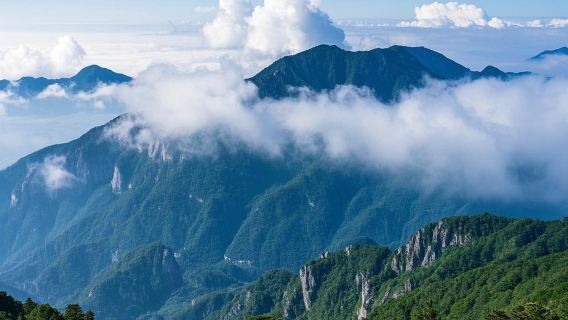
Mount Huangshan is famous for its long history. "You would not want to visit mountains after visiting the Five Sacred Mountains, and you would not want to visit the Five Sacred Mountains after visiting Huangshan." Xu Xiake, a great traveler and geographer of the Ming Dynasty, twice ascended Huangshan to witness its magnificence, exclaiming it as "a wonder in life." Dramatic Pines, grotesque rocks, sea of clouds, and hot springs are known as the “Four Musts” of Huangshan. They are the uncanny workmanship of nature and cannot be missed. In addition, the haze, snow scene, and sunrise are unique landscapes of Huangshan. Each landscape has its unique beauty and makes you feel like you are in a fairyland.China · Huangshan City
Experiences you can't miss in Poyang
Featured Cultural experiences in Poyang
View all Cultural experiences
Free cancellation
Instant confirmation
Book now for today
FromPLN 28.26

FromPLN 1,059.49
Free cancellation
Instant confirmation
Book now for tomorrow
FromPLN 170.70

Free cancellation
Instant confirmation
Book now for tomorrow
FromPLN 105.36

5.0/5
· 1 reviewFree cancellation
Instant confirmation
Book now for today
FromPLN 40.62

Free cancellation
Book now for tomorrow
FromPLN 23.49

Free cancellation
Book now for today
FromPLN 140.09

FromPLN 70.64
Featured Day tours in Poyang
View all Day tours
Free cancellation
Instant confirmation
Book now for tomorrow
FromPLN 128.55

Free cancellation
Instant confirmation
FromPLN 372.11

Free cancellation
Instant confirmation
FromPLN 121.78

Free cancellation
Instant confirmation
Book now for tomorrow
FromPLN 587.43

Free cancellation
Instant confirmation
Book now for tomorrow
FromPLN 587.43
Free things to do in Poyang
Raozhou Ancient Town
Poyang · 2.9 km from downtownJingdezhen China Ceramics Museum
Jingdezhen · 55.8 km from PoyangPoyang Lake
Duchang · 34.3 km from Poyang
Jiangxi Provincial Museum
Nanchang · 86.6 km from Poyang
Ceramic Art Avenue Taoxichuan
Jingdezhen · 61.1 km from Poyang
Huizhou Ancient City
China · She County
Sanhe Ancient Town
China · Feixi
Poyang Museum
Poyang · 3.4 km from downtown
Ancient Huizhou Cultural Tourism Area
China · She County
What travelers say about Poyang

Anonymous userOctober 4, 2026
4.0
When I went, the weather was bad and it was raining. The science museum was also closed. The core scenic area is not big and you can walk through it in a short time. If you are driving, you can also enjoy the lake view nearby.
Poyang Lake National Wetland Park

佳佳爱吃香菜October 27, 2024
5.0
Poyang Lake is the largest freshwater lake in China, with a water area of more than 3,100 square kilometers at normal water level and more than 4,100 square kilometers at high water level, equivalent to 100 Wuhan East Lakes 1. The central area of the lake is the widest part of the lake, with a water area of 1,800 square kilometers. Poyang Lake has rich and diverse natural landscapes, including the sky and water, unique lake topography, island forests and lakeside grasslands. Every summer, the lake is vast and blue, while in winter, the lake shrinks and winds like a long river 2. In addition, Poyang Lake is also famous for natural landscapes such as the "Tree of the Earth". During the dry season, the mudflats are washed by the branches of the water to form a unique natural landscape 3.
Migratory bird habitats
Poyang Lake is one of the most important wetlands in the world, home to hundreds of species of birds and aquatic animals, and is an important breeding ground for many fish. Every winter, thousands of migratory birds migrate here from the north, among which the white crane is particularly famous. Poyang Lake is one of the largest white crane habitats in the world 4. Poyang Lake has vast wetlands and abundant water and grass, forming a natural biological paradise that attracts a large number of nature lovers and ornithologists to come and watch. 4.
History and Culture
Poyang Lake not only has beautiful natural scenery, but also carries a rich historical and cultural heritage. The lake area was once a key point for water transportation in successive dynasties, and it was also a battleground for military strategists. Ancient poets and writers left many poems here, such as Song Jiang in "Water Margin", who left a tragic story in the Poyang Lake Basin. 4. In addition, there are many islands and monuments with a long history around Poyang Lake, preserving many ancient buildings and cultural relics. 5.
Ecological and Environmental Protection
Poyang Lake plays an important role in regulating the water level of the Yangtze River, conserving water sources, and improving the local climate. There are many estuaries, which have made important contributions to flood control and irrigation. However, with climate change and the intervention of human activities, the problem of water level fluctuation in Poyang Lake has gradually become prominent, and ecological protection faces challenges. 14.
In short, Poyang Lake is not only a tourist destination with beautiful natural scenery, but also a treasure land full of historical, cultural and ecological value.
Poyang Lake Grassland Scenic Area

139***03October 20, 2022
5.0
It's unique! The tour content is rich! The night view is beautiful! The staff has a good service attitude! Due to the epidemic, there are fewer tourists, the number of water shows has been reduced, and the time is a bit late, so you can go there later, and the time will be almost the same after dinner.
Raozhou Ancient Town

D23***98November 9, 2019
4.0
Poyang Lake Prairie, also known as Wunian Island, is known as "the most beautiful prairie in Jiangnan" and "the largest prairie in Jiangnan". It combines grasslands, lakes, sea of flowers, migratory birds, islands, and herds of cattle and horses. The scene is spectacular and the light and shadow are dynamic.
Wunian Island, Poyang Lake Prairie Scenic Area

yangyang,October 20, 2026
4.0
The hotel is nice and very close to Taoyangli Scenic Area. The front desk staff are very welcoming. There are also many places to eat nearby. There are buses to the high-speed rail station right outside the hotel. Very convenient.
Taoyangli Historical and Cultural District

136***74October 21, 2026
5.0
Thank you, Ms. Yu, for your professional, meticulous, and engaging lecture. In just two hours, we learned about the history of porcelain development from the Song, Yuan, Ming, and Qing dynasties, as well as the Republic of China and the founding of the People's Republic of China, and appreciated exquisite porcelain pieces from each dynasty. Furthermore, Ms. Yu used her extensive professional knowledge to introduce various methods for identifying the age, type, use, style, and quality of porcelain, opening a new world for us. She even thoughtfully reminded us of the precautions for taking photos with the Silent Buddha. Her lecture was truly sincere and packed with valuable information. This trip was incredibly rewarding and I'm full of energy! 🥰
Jingdezhen China Ceramics Museum

乂昭October 17, 2024
5.0
China's largest freshwater lake, with water reaching the sky and rippling blue waves. The water level has dropped during the dry season, and large areas of wetland grasslands have appeared, which is also unique. Poyang Lake near Jiujiang City is Hukou, and there is Luoxingdun scenic spot in Lushan City. There are many lake landscapes in the south until Nanchang.
Poyang Lake

M33***65October 20, 2026
5.0
The lights of the stilted houses on the cliff face illuminate the mountainside, and the reflections in the stream create a truly immersive fantasy atmosphere. The best spots for taking photos are the Moon-Viewing Bridge, the Hundred-Goose Bridge, and the Cliff Library.
Wangxian Valley

Natalia Valenzuela ubinaOctober 22, 2026
5.0
I woke up at 4:30 a.m. to watch the sunrise at 6:10 a.m., and it was a magical experience. The sky was painted in a thousand different colours!I then explored Xihai Grand Canyon and took the funicular. The views were magnificent! From there, you can continue hiking to other peaks or head to the cable car to descend to the city.I spent a little more time wandering around, but as the day was sunny, huge crowds started pouring in. I decided to leave before it got too busy.An unforgettable morning!
Mount Huangshan Scenic Area


