Things to do in Linxia
Explore top experiences
Top 10 attractions in Linxia


Bafang Shisanxiang
Bafang Shisanxiang is a historic Hui ethnic district preserved in the old town of Linxia. In ancient times, people established religious quarters around eight mosques, gradually forming a settlement pattern of "living around the mosque and trading around the quarter." "Bafang" (Eight Quarters) thus became the synonym for the Hui residential area in Hezhou. With its blue-brick alleys, brick-carved gate towers, and bustling daily life intertwined, walking inside feels like unfolding a long scroll of life in an old Northwest city. On the wall of Dagaxa Lane, there is a large brick carving titled "Panoramic View of Bafang Shisanxiang" that captures the entire district. The Dagongguan old residence restores the old scenes of Bafang families drinking Gaiwan tea, receiving guests, and the historical scenes of the Tea Horse Road trade and merchant caravans. In the Handicraft Museum, you can see intangible cultural heritage crafts such as carved gourds, copper fire pots, Hezhou clay sculptures, and egg carvings. The "Dragon and Phoenix" brick-carved screen wall in front of the Beixiang Mosque, dating back to the Qianlong reign of the Qing Dynasty, is also worth stopping to admire. Themed alleys like Hezhou Suyuan Lane, Silk Road Hui Merchant Lane, and Tongqu Lane, as well as the Gaiwan Tea Square and the Hongshui River area, are all perfect for strolling and exploring at a leisurely pace. If you get tired of walking, why not sit down for some "Gua Wanzis" (tea scraping)? Learn from the locals how to use the lid to scrape the tea leaves, then blow and sip a cup of Gaiwan tea, paired with Youguoguo (fried dough) and Sanzi (fried dough twists). In Bafang Weidao Lane, you can also find local snacks such as beef offal soup, sugar oil cakes, Liangpi (cold skin noodles), and sweet wheat.Linxia · 3.3 km from downtown

Bingling Cave-Temple Complex
Located in the upper reaches of Liujiaxia Reservoir, on the north bank of the Yellow River in Sigouxia, southwest of Yongjing County. On the steep and dangerous red sandstone cliffs 2 kilometers long from north to south, the cave shrines are lined up one after another, and the plank roads are suspended in the air. It is magnificent and spectacular. It is one of the three largest caves in Gansu and one of the five largest caves in my country. Bingling Temple was formerly known as "Tangshu Cave", which means "ghost cave" in Qiang language. It was called "Longxing Temple" in Tang Dynasty, "Lingyan Temple" in Northern Song Dynasty, and "Bingling Temple" after the Yongle Period of Ming Dynasty. Bingling is called "Benlang" in Tibetan language, which means "one hundred thousand Buddhas". Bingling Temple Grottoes were first built in the first year of Jianhong in the Western Qin Dynasty (420 AD). Since the Sixteen Kingdoms period, it has gone through the Northern Wei, Northern Zhou, Sui, Tang, Song, Yuan and Ming dynasties, with a history of more than 1,600 years. During the period when the Western Qin Dynasty built its capital in Linxia, the king personally visited the grottoes and wrote inscriptions, the originals of which are still preserved on the rock walls. From the time the grottoes were carved in 420 AD to the Song Dynasty, the grottoes had a great influence on Han Buddhism, Pure Land Buddhism, Huayan Buddhism and Zen Buddhism. At the end of the Yuan Dynasty and the beginning of the Ming Dynasty, the Yellow School (Gelug School) of Tibetan Buddhism was introduced to Bingling Temple. Bingling Temple Grottoes, based on the inheritance of folk art from previous generations, absorbed foreign Buddhist art and created vivid sculpture and painting art with a brand-new attitude and concise approach. Its relief pagodas and Tantric murals are as famous as those of Mogao Grottoes and Maijishan Grottoes. The grottoes are divided into three parts: the upper temple, the cave ditch and the lower temple. The lower temple is more spectacular. They are distributed on a cliff 200 meters long and 60 meters high. There are 196 caves and niches in Bingling Temple Grottoes, 694 stone statues, 82 clay sculptures, and more than 900 square meters of murals. The larger Maitreya Buddha statue from the Tang Dynasty is 27 meters high, and the smaller statue is 10 centimeters high. Among them, there are 2 caves and 1 niche excavated in the Western Qin Dynasty, 8 caves and 25 niches excavated in the Northern Wei Dynasty, 2 caves in the Northern Zhou Dynasty, 2 caves in the Sui Dynasty, and 20 caves and 113 niches in the Tang Dynasty. The artistic achievements of Tang Dynasty works were quite high, and there were more than 3,000 monks at that time. The ink inscription of the famous monk Faxian in the first year of Jianhong in the Western Qin Dynasty (420 AD) in this cave is the earliest chronological inscription preserved in the caves in China. It provides a mark for the dating of other ancient caves in the country and has very important historical value. The main body of the cave statues and murals is composed of the large seated Buddha in the natural cave No. 169 and all the small and medium-sized caves in the cliff face. Cave No. 169 was formerly known as Tangshu Cave, and is now called "Tianqiao Cave". It is 15 meters high, 8 meters deep and 20 meters wide. It is one of the earliest and best preserved caves in my country. There are three types of shapes in the cave: Buddha niches, stone carvings, and stone-based clay sculptures. Niche No. 171, located on the cliff of the cave, has a large seated Maitreya Buddha statue made of stone-based clay from the Tang Dynasty. It is carved against the mountain and is 27 meters high, majestic and solemn. The Western Qin "Manjusri Bodhisattva Asking about Illness" in the cave is one of the earliest Vimalakirti Sutra Transformations seen in my country. The original Cave No. 16 is now located in the Sleeping Buddha Hall opposite the cave group. The 8.6-meter-long clay sculpture of Bingling Temple Reclining Buddha is a reclining Buddha from the Northern Wei Dynasty, which has very important research value. The 25-cm-tall maid statue from the Tang Dynasty is one of the more precious existing cave statues in my country, and fully embodies the style of the prosperous Tang Dynasty. Next to the cliff at the entrance of Bingling Temple stands the steep Sister Peak, surrounded by scenic spots such as the Mandarin Duck Cave and the Medicine Spring, with green mountains and clear waters, dangerous peaks and strange rocks.Yongjing · 28.7 km from Linxia

Hong Garden
Linxia · 3.9 km from downtown

Jiuzhaigou National Park
Jiuzhaigou National Park is located in Jiuzhaigou County of Ngawa Prefecture. With its towering snow-capped peaks, dense forests, and vibrantly colored pools and shoals, crystal-clear streams meander through the forests and shallows. Combined with Tibetan wooden houses, prayer flags, and the unique traditional customs of the Tibetan and Qiang ethnic groups, Jiuzhaigou National Park is often referred to as a "beautiful fairyland". Jiuzhaigou National Park features a Y-shaped layout, consisting of three main valleys: Shuzheng Valley, Rize Valley, and Jiuzhaigou-Zechawa Valley, with a total length of over 50 km.The attraction is equipped with eco-friendly sightseeing vehicles that stop at designated stations. Visitors can wait at each station and conveniently tour various attractions within the site by taking the sightseeing vehicles.China · Jiuzhaigou

Dagongbei Pavilion
Dagongbei Pavilion is located in the western suburbs of Linxia, adjacent to Renmin Hongyuan, and is the site of the mausoleum of Qi Jingyi, the founder of the Dagongbei Menhuan.Linxia · 3.9 km from downtown

hua kai lin xia bu ye cheng
Linxia · 1.2 km from downtown

Bingling Temple World Cultural Heritage Tourist Area
Bingling Temple World Cultural Heritage Tourist Area is located in Yongjing County, Linxia Hui Autonomous Prefecture, Gansu Province. This cultural attraction combines Buddhist cave art with natural scenery, covering a total area of 180 square kilometers. It consists of three main sections: Bingling Lake, Gansu Bingling Danxia National Geopark (Bingling Stone Forest), and Bingling Temple Caves. In December 2020, it was designated as a National 5A-level Tourist Attraction by China's Ministry of Culture and Tourism. Bingling Lake is the reservoir of Liujiaxia Hydropower Station, named after the Bingling Temple at its far end. With crystal-clear, unpolluted water meeting national Grade II drinking standards, this vast misty lake stretches like an endless green silk ribbon through mountain ranges, blending southern China's elegance with the plateau's grandeur—a dream destination for travelers. Liujiaxia Hydropower Station, China's first independently designed million-kilowatt hydro project in Asia, is recognized as a National Industrial Heritage Education Base. The Binglingshi Stone Forest is a Danxia landform composed of Cretaceous purplish-red fine sandstone from the early Cenozoic era. In 2011, it was officially designated as the Gansu Bingling Danxia National Geopark by the Ministry of Land and Resources. Within the geopark, thousands of towering peaks and countless crisscrossing ravines form a labyrinth of winding tributary valleys, creating a surreal stone forest landscape alongside uniquely shaped rock formations. This natural sculpture gallery holds immense value for geological research, tourism development, natural aesthetics, and ecological conservation. The Bingling Temple Grottoes, dating back over 1,600 years to the Western Qin period of the Sixteen Kingdoms era, is a nationally protected cultural heritage site and was inscribed on the UNESCO World Heritage List in 2014. The grotto complex consists of three main sections: the Lower Temple area, Upper Temple area, and Donggou area. It preserves 216 cave shrines, over 800 Buddhist statues, more than 1,000 square meters of murals blending Tibetan and Han Chinese artistic styles, 56 stupas, and 438 cultural relics. The site contains ink inscriptions from the first year of Jianhong era (420 AD) of Western Qin - the earliest dated Buddhist cave inscription found in China, which serves as a crucial benchmark for dating early grotto art. The Bingling Temple World Cultural Heritage Tourist Area boasts abundant resources, where natural views and cultural landscapes complement each other to create a magnificent and mysterious panorama. Every visitor can embark on a perfect journey here to explore cultural heritage and experience the beauty of nature.Yongjing · 25.5 km from Linxia

Yongjing Liujiaxia Tourist Resort
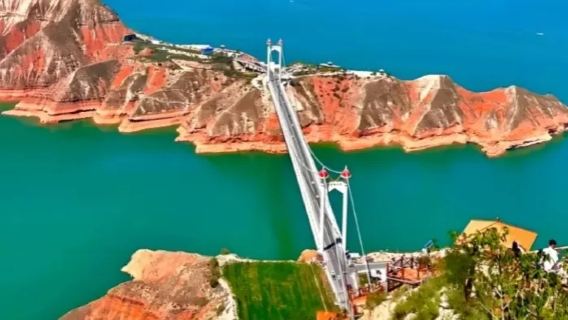
Located in Yongjing County, Linxia City, Gansu Province, Liujiaxia is home to the Liujiaxia Hydropower Station, Bingling Temple Grottoes and Tai Chi Island, as well as Liujiaxia Reservoir. Beginning from Liujiaxia Dam, Liujiaxia Reservoir reaches the narrows of Bingling Temple in the west, connects to Jiedong County and Linxia County in the south, and borders Yongjing County in the north. Liujiaxia Reservoir occupies a vast area. The reservoir sits on plateaus and in canyons, allowing visitors to return to the beauty of nature.Yongjing · 37.6 km from Linxia

Linxiashi Museum
The main building of the museum has two exhibition halls, the "Painted Pottery Hall" and the "Ethnic Hall", and an ancient tomb of the Jin Dynasty. By the 1980s, the state museum had collected nearly 3,000 cultural relics of various types, including more than 2,000 pottery, as well as stone, bone, bronze, porcelain, iron, calligraphy and painting. The Painted Pottery Museum has selected more than 1,700 pieces of exquisite painted pottery from Quanzhou, and various types of painted pottery culture are gathered. The painted pottery in the museum is arranged in the chronological order of the cultural types they represent. Among them, there are more than 60 pieces of Majiayao painted pottery, more than 350 pieces of Qijia painted pottery, more than 170 pieces of Xindian painted pottery, more than 270 pieces of Bianjialin painted pottery, more than 180 pieces of Banshan painted pottery, more than 640 pieces of Machang painted pottery, and 25 pieces of Siwa pottery. The State Museum has also restored a tomb of Wang Ji, a lieutenant of Jinyi in the 15th year of Dading in the Jin Dynasty (1175). It consists of a corridor, a tomb door, and a tomb chamber. The chamber is 2.40 meters deep, 2.20 meters wide, and 2.65 meters high. It has a brick-stacked Bagua-shaped vault. The surroundings are decorated with carvings and molded flower bricks, which are very gorgeous and exquisite. It is the most complete and exquisite Jin Dynasty brick chamber tomb restored in my country so far. You can appreciate the brick carving art of the Song and Jin Dynasties.Linxia · 279m from downtown
Lanzhou Danxia Geological Park
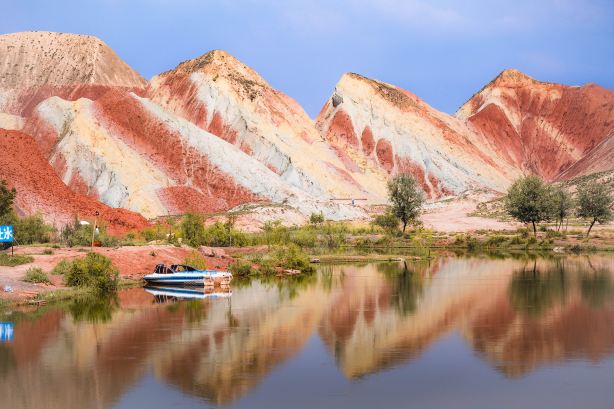
Lanzhou Danxia Geological Park is a key cultural tourism project in Gansu Province and a comprehensive cultural tourism initiative prioritized by the Lanzhou Municipal Committee and Government. Located by the Yellow River, the park is just 13 km from downtown Lanzhou and 30 km from Lanzhou Zhongchuan International Airport, making it one of the closest Danxia landform clusters to a major urban center in China. With a total planned area of 400 sq km and a core visiting area of 25 sq km in its first phase, it ranks among the largest discovered landscapes of its kind in the country. The park primarily features red mountain bay formations, along with spectacular Danxia cliffs, isolated peaks, secluded valleys, narrow gorges, and balancing rocks. Its colorful mountains set against winding waterways create a masterpiece of Danxia landform scenery. The attraction features seven viewing platforms showcasing the Danxia landforms: Silk Road Glow, Silk Road Eagle, Flying Apsaras Exploration, Nine-Colored Danxia, Danxia Reflecting Sky, Emerald Peaks Rippling Sky, and Danxia Summit Scenic View. It also includes the Ancient Silk Road Gateway, Shajing Tribe Cultural Square, Desert Bells Scenic Boulevard, and a 2,550m Danxia boardwalk viewing area. As a key cultural tourism project in the province, Lanzhou Danxia Geological Park adheres to the principles of "ecological protection, green development, preserving original features, and moderate development." Leveraging Lanzhou's unique resource advantages and focusing on the domestic tourism market, it aims to cultivate new growth drivers for Lanzhou's cultural tourism industry and establish a new highland for cultural tourism in the city.Yongdeng · 79.2 km from Linxia
Experiences you can't miss in Linxia
Featured Cultural experiences in Linxia
View all Cultural experiences
Free cancellation
Instant confirmation
Book now for tomorrow
9% off
Limited-time sale
FromSEK 370.00SEK 411

FromSEK 1,690.00

5.0/5
· 3 reviewsFree cancellation
Instant confirmation
FromSEK 1,487.00
FromSEK 2,499.00

FromSEK 2,535.00
FromSEK 2,451.00
FromSEK 2,451.00
Featured Day tours in Linxia
View all Day tours
4.8/5
· 223 reviews· 1.1k bookedFree cancellation
Instant confirmation
27 consecutive positive reviews
FromSEK 1,309.00

4.3/5
· 7 reviews· 76 bookedFree cancellation
Instant confirmation
Book now for tomorrow
FromSEK 715.00

4.9/5
· 62 reviews· 350 bookedFree cancellation
Book now for today
96.8% of travelers recommend
FromSEK 172.00

5.0/5
· 10 reviews· 56 bookedFree cancellation
Book now for tomorrow
FromSEK 503.00

5.0/5
· 5 reviews· 22 bookedFree cancellation
Instant confirmation
Book now for tomorrow
FromSEK 752.00

4.9/5
· 79 reviews· 494 bookedFree cancellation
Instant confirmation
Book now for today
97.5% of travelers recommend
FromSEK 548.00
5.0/5
· 16 reviews· 95 bookedFree cancellation
Instant confirmation
Book now for tomorrow
77 travelers saved
FromSEK 622.00
5.0/5
· 2 reviewsFree cancellation
Instant confirmation
FromSEK 879.00
More things to do
Private Tours in Linxia
View More Private Tours in Linxia


Free things to do in Linxia
Bafang Shisanxiang
Linxia · 3.3 km from downtownHong Garden
Linxia · 3.9 km from downtownhua kai lin xia bu ye cheng
Linxia · 1.2 km from downtownYongjing Liujiaxia Tourist Resort
Yongjing · 37.6 km from LinxiaLinxiashi Museum
Linxia · 279m from downtown
Liujiaxia Bridge
Dongxiang Autonomous County · 26.9 km from Linxia
Gansu Provincial Museum
Lanzhou · 70.3 km from Linxia
Yellow River Three Gorges
Yongjing · 27.1 km from Linxia
Hezheng Paleozoological Museum
Hezheng · 20.8 km from Linxia
Lanzhou Old Street
Lanzhou · 68.2 km from Linxia
What travelers say about Linxia

M37***45September 5, 2026
4.0
Hidden within the Eight Squares and Thirteen Lanes is China's first museum dedicated to covered bowl tea—the Hezhou Mingyuan Covered Bowl Tea Culture Museum! The entire museum is housed in an ancient Qing Dynasty residence in Northwest China, preserving the "style of the Tang and Song Dynasties and the layout of the Ming and Qing Dynasties." Even the walls are decorated with blue and white porcelain covered bowls—it's incredibly unique! A leisurely stroll through it is so relaxing!
Bafang Shisanxiang

游来游去的鱼鱼🐡September 30, 2026
5.0
The Bingling Temple Grottoes are hailed by scholars as an "encyclopedia of Chinese grottoes," holding an irreplaceable and important position in my country's grotto art. It is not only one of the three major grottoes in Gansu, but also the first Yellow River grotto on the Silk Road.
Bingling Cave-Temple Complex

LHCYNovember 9, 2021
5.0
October is a good time to appreciate chrysanthemums. The chrysanthemums in the Red Garden are graceful, elegant, and beautiful, which makes people envious. Look at the pink as rouge, the red as the sunset, the yellow as the gold in the garden, the curled silk as if it is cut by a skilled hand, and the colorful as if it is a painting. It is really more beautiful than peony, and the beauty is even more amazing. The pavilions and towers in the Red Garden are more graceful and charming under the shade of these colorful chrysanthemums.
Hong Garden

Anonymous userOctober 22, 2026
4.0
This place is totally worth a visit as the scenery is truly beautiful. However, it may be a little bit crowded during peak season. Bus boarding could be an issue during peak season. It may take more time to travel within the park under such situation
Jiuzhaigou National Park

龙行天下之飞龙在天February 11, 2026
5.0
Linxia is one of China's major areas inhabited by ethnic minorities, home to 31 ethnic groups including Han, Tibetan, and Tu, among whom are Hui, Dongxiang, Bao'an, and Salar minorities who practice Islam. Linxia is also the center of Islam in Northwest my country, with Islam spreading widely and exerting a profound influence. The region is home not only to the four major Sufi sects of Islam in China—the Gedimu, Ikhwani, Salafyya, and Xidaotang—but also the four major Sufi orders—the Zheherenye, Hufuye, Kubulinye, and Gaderenye. Throughout its history, Linxia has been influenced by both Han Chinese Confucian culture and Islam, resulting in a distinctive Islamic culture and architecture. While mosques are typical representatives of Islamic culture and architecture, another widely distributed and historically significant type of Islamic architecture exists in Linxia—the Gongbei (宮北).
The Gongbei is a collective term for the burial complexes of Sufi Sufi masters in Chinese Islam. Because Linxia is the birthplace of the Sufi order in Chinese Islam, numerous Gongbei are scattered throughout the region. In its formation and development, the Gongbei (sacred tombs) of Linxia absorbed traditional Chinese cultural thought, adhered to the requirements of Islamic religious architecture, and was also influenced by the traditional architectural forms of the Linxia region, resulting in a distinctive architectural style and religious culture. Simultaneously, the Gongbei served as an important link for maintaining social relations among the Linxia Sufi order's Muslims and a crucial site for the development and dissemination of Islam. The Gongbei are not only religious sites but also witnesses to the Sinicization of Islam. Today, many Gongbei are listed as cultural relics protection units, maintaining their religious functions while also becoming important windows for studying Chinese Islamic culture.
Dagongbei Pavilion

M28***94August 5, 2025
5.0
I drove there on a self-driving tour from Liujiaxia Town. It was a long way to go. Some of the statues on the grotto walls were blocked by gauze and could not be seen clearly. Some were still empty. Only the Buddha statues were magnificent. I took a long detour back to the entrance. It is suitable for scholars and scholars. I think it is okay. If you want to see the special grottoes, you need to make a separate reservation and buy a ticket, which seems to be 300 yuan.
Bingling Temple World Cultural Heritage Tourist Area

M10***51July 2, 2026
5.0
The Liujiaxia Reservoir is a large-scale hydroelectric power station built independently during the First Five-Year Plan. The green Yellow River and the earthy yellow mountain valleys complement each other beautifully, and the scenery along the bridge is also stunning. It's definitely worth a visit!
Yongjing Liujiaxia Tourist Resort

小小导游爱旅游December 29, 2024
4.0
Linxia Museum has a rich collection, which comprehensively and systematically displays the profound historical heritage of Majiayao culture. The museum is full of colorful pottery, stone tools, jade, gold and silver ornaments, etc., which are exquisite and make people feel as if they have traveled back to that distant era and felt the wisdom and ingenuity of the ancients.
Linxiashi Museum

Patrick Woodbourne ClarkeOctober 22, 2026
5.0
Lanzhou Danxia Geological Park is fabulous. One of the top three things I have done on this tour. I used Trip.com to get out to the park and that was very easy. Shuttle buses are necessary to get between the various vantage points. I would come for longer next time and do the zip line. I got an 8am bus from Xiaoxihu Subway Station and it leaves the Park at 12pm to return back to the city.
Lanzhou Danxia Geological Park


