Things to do in Gaoqing
Explore top experiences
Top 10 attractions in Gaoqing


Wei Family Manor
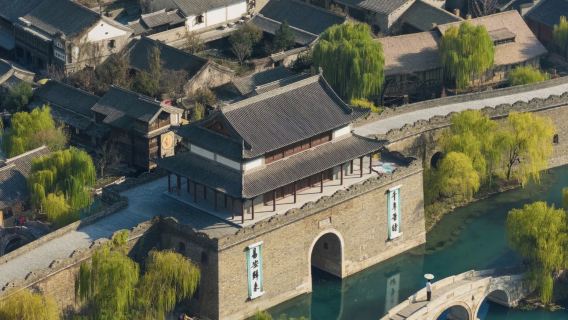
Wei Family Manor is located in Weiji Town, Huimin County, Shandong Province. As a nationally significant cultural heritage site and a AAA-rated tourist attraction, it is renowned as one of "China's Three Great Manors" alongside Mou Family Manor in Yantai and Liu Wencai Manor in Sichuan. It stands as the only surviving castle-style manor in China. The Wei family was a prominent noble clan in northern Shandong, with over 20 members across six generations serving as imperial officials, some reaching the high rank of second-grade official. They owned over 3,000 acres of fertile land around Weiji Village and operated numerous banks and pawnshops across northern China under the business names "Xiehe" and "Xiezeng." The Weis represented a powerful trinity of bureaucrats, landlords, and merchants. Wei Family Manor consists of three architectural complexes: Shude Hall, Xiyi Hall, and Fushou Hall. Built during the Qing Dynasty, this grand estate features exquisite craftsmanship and spans 32,543 square meters with nearly 100 preserved rooms, boasting over a century of history. The Shude Hall stands out as a distinctive feature—originally the private residence of Wei Zhaoqing, a Qing Dynasty Tongzhi (sub-prefect) of Wuding Prefecture. Constructed between 1890 and 1893 during Emperor Guangxu's reign, it was designed by master architects from the imperial construction bureau and meticulously built by skilled artisans. The estate faces east, boasting an imposing layout that integrates residential quarters, a plaza, ponds, gardens, and an ancestral hall. Its unique architectural style blends military-defensive fortress walls with the traditional Beijing courtyard-house design, creating a remarkable fusion. The castle-style residence is the main structure of the manor complex, featuring rectangular fortification walls that follow the architectural patterns and characteristics of ancient Chinese city walls. It includes city gates, gate towers, horse-face bastions, and innovatively added protruding watchtowers. The walls stand 10 meters high with a 1.5-meter-wide top, equipped with battlements and parapets. Thirteen niches for armed personnel to conduct outward shooting are embedded along the inner walls. The northern parapet is designed with sawtooth crenellations, some sections so narrow they allow only single-file movement—embodying the military defense philosophy of "one warrior holding the pass against ten thousand." With its strong defensive features and adaptation of fortress architecture into traditional dwellings, it serves as a prime example of Sun Tzu's *The Art of War* applied to residential design. The inner residence forms the core of the manor complex, designed and constructed according to the Qing Dynasty's "Ministry of Works Engineering Standards." Each individual building is arranged along a central axis, creating independent units. These structures are interconnected by ceremonial gates, service passages, and secret tunnels, skillfully blending the architectural artistry of northern courtyard houses with southern loft buildings. The design inherits the symmetry, precision, and grandeur of northern architecture while showcasing the flexible spatial arrangements characteristic of southern styles. The manor features a mill courtyard with substantial underground coal reserves and large stockpiles of grain and oil. In times of war or prolonged famine, the estate could sustain itself for three years with closed gates—fully self-sufficient in food, clothing, and supplies—reflecting the feudal society's self-reliant economy. The Xiyi Hall and Fushou Hall exhibit exquisite craftsmanship, each with distinct stylistic features and strong regional influences. Wei Family Manor boasts profound cultural heritage, showcasing exquisite architectural artistry and the vast depth of Chinese national culture. With recent extensive restoration and development efforts, along with enriched interior displays, the manor strives to regain its former glory, becoming an ideal destination for visitors to experience the vibrant folk culture of northern Shandong.Huimin · 14.8 km from Gaoqing

Weiji Ancient Village
Located on Tonghan Road, Weiji Town, Huimin County, Binzhou City, Shandong Province, Weiji Ancient Village is a scenic spot imitating the ancient architectural style of the Ming and Qing Dynasties. It is divided into five streets: Flavor Snack Street, Handicraft Workshop Street, Folk Theme Street, Bar Culture Street and Yuanding Street. There is special food, handicrafts and local folk activities, such as the dragon and lion dance, shadow play and acrobatics.Huimin · 15.5 km from Gaoqing

Zhoucun Ancient Town
Zhoucun Ancient City is located in the western urban area of Zhoucun. It is a handicraft industry and commercial city established during the economic transformation in late feudal times and remains well-preserved after hundreds of difficult years. The ancient city crosses through the surrounding city. Full of shops and possessing a wildly different architectural style, the ancient city has been called “China's living architectural museum of ancient commerce.” Zhoucun is famous for its handicrafts, auxiliary agricultural products, and silk-weaving industries. It developed into an important commercial center in north China during the Ming and Qing dynasties (1368-1912).Zibo · 41.4 km from Gaoqing

Mount Taishan
Crowned as "The King of the Five Sacred Mountains", Mount Tai has been one of China's most famous mountain peaks since ancient times. A large and impressive rock mass covering 25,000 ha and rising to 1,545 m above the surrounding plateau, Mount Taishan is considered one of the most beautiful scenic spots in China and was an important cradle of oriental East Asian culture since the earliest times. The mountain was an important object of the cult worship of mountains even before 219 BCE, when the Qin Emperor paid tribute to the mountain to inform the gods of his success in unifying all of China. Watching the sunrise and catching the spectacular sea of clouds are common activities that visitors engage in. You are also encouraged to explore the ancient sites, engravings, and religious temples to understand the role of Mount Tai in China's long history.China · Tai'an

Baotu Spring
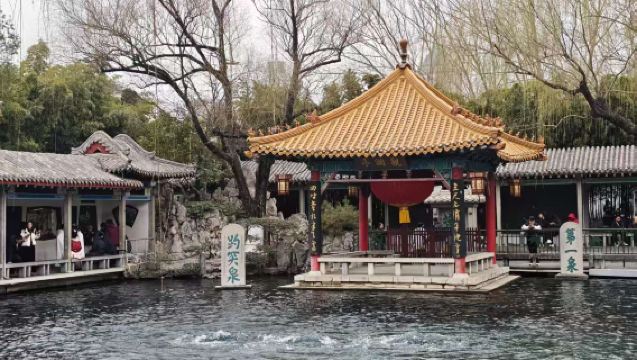
Baotu Spring is located in the bustling downtown area of Jinan, bordered by Qianfo Mountain to the south, Daming Lake attraction to the north, and connected to Quancheng Square to the east. This spring-themed garden is renowned as the "No. 1 spring under heaven" and ranks first among Jinan's "72 famous springs," with a history spanning over 2,000 years. It has also frequently appeared in literary works, most notably in Lao She's "Baotu Spring." Visitors come here to witness the spectacular sight of the three gushing springs. The main spring serves as the park's centerpiece, with its crystal-clear water gushing in three separate jets day and night, reaching several feet high during peak flow. The spring is surrounded by large stone masonry and guardrails, allowing visitors to overlook the spectacular sight of the three jets from the railings. A dark green stone tablet inscribed with "No. 1 spring" stands nearby, bearing the calligraphy of Licheng's Wang Zhonglin from the Tongzhi era of the Qing Dynasty. In the vicinity, over thirty other famous springs are scattered, including Jinxian Spring, Shuyu Spring, Xibo Spring, Liuxu Spring, Huanghua Spring, Dukang Spring, and Bailong Spring. July and August, when local rainfall is abundant, make for the best season to observe these springs. In the height of summer, visitors can get up close with the springs in the park. Some springs have no railings around them, with stone paths in the pools where water flows over. Visitors can step into the pools to interact with the water, walking on the stone paths where their feet will get wet from the cool spring water. Besides water interaction, there are free drinking springs available for visitors by the pools. On the east side of the springs stands the Wangheting teahouse, specially catering to visitors.This springFragrant tea brewed with water at a moderate price. In addition to the springs, another highlight of the park is its magnificent south gate, adorned with grandeur and elegance. The horizontal plaque above the gate, inscribed with "Baotu Spring" in golden characters on a blue background, bears the imperial handwriting of Emperor Qianlong from the Qing Dynasty. It is acclaimed as the "first gate" of Chinese classical gardens. In previous years, seasonal water stoppages frequently occurred here, but through recent conservation efforts, normal water levels have been largely restored. Additionally, the attraction regularly hosts various cultural events. Every year on the first day of the lunar new year, a lantern festival is held for 20 days. In late September, there's a spring water culture festival lasting about 10 days, featuring folk activities, calligraphy and painting exhibitions, and traditional opera performances for visitors to enjoy. From late October to late November, a chrysanthemum exhibition takes place where the golden fall scenery of gushing springs and blooming chrysanthemums creates a spectacular sight well worth seeing. In addition, the attraction has launched a cruise route. After visiting the attraction, interested visitors can board the cruise at the dock, passing through the west gate bridge in Jinan's old town, the east gate of Wulongtan Park, and entering Wulongtan Lock, Jinan's first passenger ship lock in history, where they can experience a drop of over 2 m. Sitting on the east side of the boat, visitors can also see the relief of "Jinan's eight scenic views". The riverbanks along the route are lined with aquatic plants, and the water is crystal clear. The cruise finally passes through Yanbo Bridge and enters the Daming Lake attraction.Jinan · 91.7 km from Gaoqing

Tsingtao Beer Museum
The Tsingtao Beer Museum is located at No. 56 Dengzhou Road, the birthplace of Tsingtao beer. This century-old factory, housed in a 1903 German-style industrial complex, witnesses China's beer industry journey from its infancy to prominence. As China's first beer-themed model for industrial heritage revitalization, the museum transforms weathered red-brick workshops into immersive spaces using precious early equipment like old motors, mash kettles, and boiling kettles. Visitors walking through the century-old memory corridor can touch over 30,000 artifacts from the German occupation era while overlooking the smart production lines of the "lighthouse factory" through glass walls. Through the dialogue between traditional wooden fermentation tanks and fully automated filling equipment, they decode the evolution of Chinese manufacturing from artisanal heritage to digital transformation. With the innovative concept of "living heritage + technological empowerment," the museum breaks free from the static display constraints of industrial sites. The VR brewing lab allows visitors to become brewers adjusting malt ratios, while the hop recognition system decodes the scientific secrets behind beer flavors. Personalized beer label printing customizes brews, turning taste into portable urban memories. This cultural landmark, bearing Qingdao's industrial DNA, not only showcases its benchmark value in cultural-tourism integration through honors like "national first-class museum" and "China's top 10 cultural heritage tourism cases," but also injects more sustainable vitality into the century-old factory by being selected as a "national cultural industry demonstration base." It continues to brew the city's cultural richness from industrial heritage amid the tides of time.China · Qingdao

Laoshan Scenic Spot
Laoshan scenic spot is located in eastern Qingdao, bordering the Yellow Sea to the east and south. Known as the "famous mountain on the sea", its highest peak stands at approx. 1,100 m above sea level.JufengThe attraction is renowned as a famous Taoist mountain for its grandeur, magnificence, uniqueness and beauty. Its Taoist temples, sunrise and sea of clouds allPrestigious. The scenic area mainly consists of seven major scenic zones: Laoshan's grand peak scenic area, Liuqinghe scenic area, Laoshan's taiqing scenic area, Qipan stone, Laoshan's yangkou scenic area, Laoshan's jiushui scenic area, and Laoshan's hualou scenic area. There are four touring routes in total, including three land routes (southern line, eastern line, and central line) and one water route. The scenic highlights include grand peak sunrise, taiqing water moon, and haiqiao fairy mound.Huayuan stacked stonesJiushui mingyi and others together form the twelve scenic spots of the attraction. Huashan scenic area in Laoshan is far from the sea and not located inLaoshan MountainThe area sees fewer visitors. The Laoshan Jiushui scenic area is renowned for its water features, with streams and springs throughout, offering beautiful scenery. For the average visitor, the truly worthwhile routes are the Laoshan grand peak scenic area and the Liuqinghe-Yangkou scenic area line - one day is sufficient for each route. These areas contain the most spectacular natural landscapes of the attraction. The liuqinghe scenic area - laoshan yangkou scenic area, also known as the southern route, is one of the earlier developed attractions here. It closely follows the coastline and features the famous attraction laoshan taiqing palace, making it the most popular route for visitors. The basic route through the attraction is liuqinghe scenic area - taiqing palace scenic area - huayan temple, with the endpoint at laoshan yangkou scenic area. Since the highlight of this route lies in the laoshan yangkou scenic area, it's recommended to plan your time wisely when visiting the preceding attractions. Laoshan Taiqing palaceStrange tales from a Chinese studioMediumLaoshan MountainThe birthplace of the Taoist priest's story. Inspired by his visit to Laoshan Taiqing Palace, Pu Songling wrote "The Taoist Priest of Laoshan" here. Visitors can see the wall described in Pu Songling's work where the Taoist priest of Laoshan walked through. Huayan Temple - the existing Buddhist temple in the attraction. Since the Laoshan Yangkou scenic area is close toHuanghaiHere you can enjoy the sea view and feel the ocean breeze. Of course, besides its beautiful scenery, the Yangkou scenic area of Laoshan Mountain offers the challenging Mitian cave - winding, steep, and narrow, with sections so dark you can't see your hand in front of your face and so tight you have to squeeze through sideways, significantly enhancing the adventure. You can reach Mitian cave either on foot or by cable car. Upon reaching the mountaintop, you can take photos, admire the scenery, and gaze at the Yellow Sea in the distance. Remember to bring a flashlight to fully appreciate the cave's spectacular formations. Besides the Laoshan Yangkou scenic area, the second highlight of the attraction is the Laoshan grand peak scenic area. This area features the main peak of the mountain, with the summit being the highest point. Primarily focused on hiking, it's the most physically demanding part of the attraction. The grand peak scenic area boasts magnificent rock formations - you can see the sea on clear days and a sea of clouds on overcast days. Watching the sunrise from the summit offers breathtakingly beautiful views.China · Qingdao

Ancient Town of Qingzhou
Qingzhou is one of the ancient nine provinces of China. Since the early Western Han Dynasty, six cities—Guang County, Guanggu City, Dongyang City, Nanyang City, Dongguan Weizi City, and Qicheng—were successively built on this land, with a continuous urban history spanning over two thousand years. Today, the Ancient Town of Qingzhou has been comprehensively protected and restored, forming three major districts: the Beiguan ancient block in Dongyang City, the Ouyuan historical and cultural block and the South Gate block in Nanyang City, and the Zhaode ancient block in Dongguan Weizi City. Government buildings, traditional residences, and classical gardens are scattered across hundreds of ancient streets and alleys, such as North Gate Street and East Gate Street, with their blue bricks and dark tiles showcasing distinct Ming and Qing architectural styles. Unlike many entirely reconstructed ancient towns, this is a "living ancient town," where original residents still live in the old streets and alleys, and intangible cultural heritage items like the cuoqin are passed down on the streets, blending the vibrancy of daily life with ancient charm. A visit can begin by ascending the Fucai Gate Tower at the south gate of ancient Nanyang City for a panoramic view of the town's sea of dark tiles. Ouyuan is a preserved classical garden within the town, originally the eastern garden of the Ming Dynasty's Prince of Heng's residence and later the private garden of Feng Pu, a grand secretary during the Qing Kangxi era. Its three-peak rockery embodies the grandeur of northern landscapes. Figures like Fan Zhongyan and Ouyang Xiu once served as officials here, and Li Qingzhao lived in Qingzhou for over a decade, composing numerous ci poems. Historical relics like the Qingzhou Prefecture Examination Hall are also scattered throughout the streets, where traces of this cultural legacy can often be encountered. The main street is densely lined with shops, but to avoid crowds, one can turn into the side alleys or head straight to Zhaode Ancient Street—where rows of Ming and Qing-era houses remain, with wooden doors, stone steps, and flagstone paths offering a glimpse of old Qingzhou's daily life.Qingzhou · 79.6 km from Gaoqing

Daming Lake Scenic Area
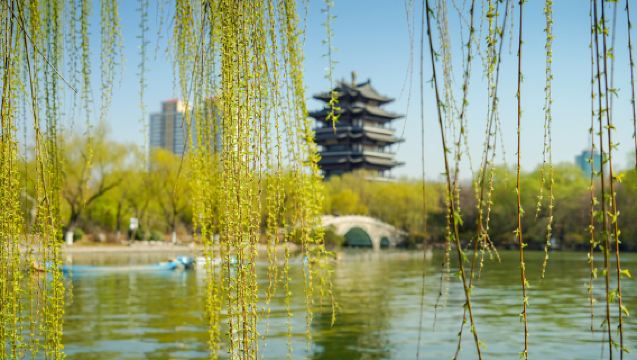
Daming Lake Scenic Area is located in the northeast of downtown Jinan, the northern part of the Old Town. It is a park that integrates bodies of water, garden landscape, and ancient architecture. Daming Lake is in the center of the park. Or one could say that the park is built along the lake. Daming Lake is a natural lake. The water source comes from many springs in the city. It has a long history, dating back to the Northern Wei Dynasty. In the park, you can visit the Lao She Memorial. In summer, you can enjoy the lotus blossoms in the garden.Jinan · 89.9 km from Gaoqing

The Best Spring In The World
The Best Spring In The World is located in downtown Jinan, featuring "one river (the moat), one lake (Daming Lake), three springs (the Baotu Spring, Heihu Spring, and Wulongtan spring clusters), and four parks (Baotu Spring Park, Huancheng Park, Wulongtan Park, and Daming Lake Park)." The attraction centers around Baotu Spring, renowned as the "No. 1 Spring Under Heaven." Its waters flow into rivers and converge into lakes, harmoniously blending with the ancient Mingfu City. To the north lies Wulongtan (Five Dragon Pool), while to the east stretches Jinan's Huancheng Park (home to the Black Tiger Spring and other springs), both highly celebrated in Jinan. These springs boast exceptional water quality. Daming Lake, a natural lake formed by the convergence of numerous springs, receives water from its southern shore. When full, the water flows out through the Northern Water Gate, built during the Song Dynasty on the lake's north shore. The lakebed consists of impermeable igneous rock, preventing flooding during heavy rains or drought. Often described as "a confluence of springs merging to embrace the Jiluo region," it's hailed as the "Pearl of the Spring City." Similarly, the moat formed by spring waters encircles the ancient city like a jade belt, offering scenic cruise rides along its course. The attraction boasts stunning natural scenery and rich cultural heritage, featuring not only springs, rivers, and lakes but also numerous historical landmarks. Highlights include the Chaoran Tower dating back to the Yuan Dynasty and the Luoyuan Hall originally built during the Northern Wei Dynasty (now a Ming-era structure). Historical sites include the Luoshang Terrace, the former residence site of Qin Qiong, and the Beishui Gate. Notable former residences include the Nanfeng Ancestral Hall, Jiaxuan Ancestral Hall, Li Qingzhao Memorial Hall and Yi'an Old Residence, Tiegong Ancestral Hall, and Lao She Memorial Hall. Red tourism sites include the Jinan Massacre Memorial and the former site of the Shandong Provincial Committee of the Communist Party of China.Jinan · 89.8 km from Gaoqing
Experiences you can't miss in Gaoqing
Featured Food & drink in Gaoqing
View all Food & drink

5.0/5
· 3 reviews· 30 bookedFree cancellation
Instant confirmation
Book now for tomorrow
FromPHP 1,320.76
FromPHP 1,320.76
Free cancellation
Instant confirmation
FromPHP 1,877.36
Free cancellation
Instant confirmation
FromPHP 1,584.91
Free cancellation
Instant confirmation
FromPHP 9,018.87
Featured Cultural experiences in Gaoqing
View all Cultural experiences
5.0/5
· 2 reviews· 28 bookedFree cancellation
Book now for tomorrow
FromPHP 377.36
FromPHP 10,720.42


FromPHP 10,720.42
FromPHP 16,509.44
FromPHP 13,962.27

FromPHP 15,651.81
Featured Day tours in Gaoqing
View all Day tours
Free cancellation
Instant confirmation
Book now for tomorrow
FromPHP 3,655.67
FromPHP 10,720.42
5.0/5
· 1 reviewFree cancellation
Instant confirmation
Book now for tomorrow
FromPHP 3,752.15
FromPHP 16,603.78
Free things to do in Gaoqing
Wei Family Manor
Huimin · 14.8 km from GaoqingImmediate access, Book now for today, Cancel anytimeWeiji Ancient Village
Huimin · 15.5 km from GaoqingZhoucun Ancient Town
Zibo · 41.4 km from GaoqingMount Taishan
China · Tai'anImmediate access, Book now for today, Cancel anytimeBaotu Spring
Jinan · 91.7 km from GaoqingImmediate access, Book now for today, Cancel anytimeTsingtao Beer Museum
China · QingdaoImmediate access, Book now for today, Cancel anytimeLaoshan Scenic Spot
China · QingdaoImmediate access, Book now for today, Cancel anytimeAncient Town of Qingzhou
Qingzhou · 79.6 km from GaoqingImmediate access, Book now for today, Cancel anytimeDaming Lake Scenic Area
Jinan · 89.9 km from GaoqingThe Best Spring In The World
Jinan · 89.8 km from Gaoqing
What travelers say about Gaoqing

136***37June 18, 2026
5.0
The escape routes within the traditional courtyard house are incredibly ingenious and well worth exploring. It's best to do some research beforehand, or hire a guide on-site; it will definitely be worth the trip. Security is as tight as the escape routes on a city wall; rules are as strict as the well water used by the women; the guards are as mysterious as the cabinets where bodyguards hide; and the escape routes are as ingenious as the design of hidden doors and drawbridges. While not as grand as the Wang Family Compound, nor as famous as the Qiao Family Compound, the Wei Family Manor is a system in itself, full of mysteries and intricate calculations—it's truly fascinating.
Wei Family Manor

M12***11October 4, 2024
5.0
I came here mainly to see the Wei's Manor, and the ancient village is a few minutes away from the manor. Although I came during the National Day, there were not many people because the weather was cool and the temperature was suitable. I strolled around for more than 2 hours. There were different performances in different places. I strolled around while watching the performances, and it was good overall.
Weiji Ancient Village

爱旅游的金子2026October 7, 2026
5.0
This is a relatively famous tourist attraction in Zibo. Because it was the National Day Golden Week, it was packed with tourists, making the already narrow streets even more congested. The streets are lined with a dazzling array of small shops, and there are also several venues to visit.
Zhoucun Ancient Town

Anonymous userOctober 19, 2026
4.0
Suggest to reach in in early afternoon for a short trek around the area and catch the sunset. stay for a night to see the sunrise next day. Very beautifu & memorablel views. Great food condidered considered its so high up..
Mount Taishan

M49***80October 16, 2026
5.0
We accompanied a family member to Qilu Hospital for a medical appointment and chose this Ji Hotel. It's very close to the hospital, less than a ten-minute walk, which is very convenient. The room was clean and tidy, and the environment was quiet, allowing for a good rest. There's also a laundry and fitness area. The front desk was responsive, and check-in was smooth, making it ideal for accompanying family members to medical appointments. Most importantly, parking is convenient.
Baotu Spring

BGuatOctober 18, 2026
5.0
Excellent experience at the Tsingtao Beer Museum! 🍺 We learned about the history of Tsingtao Beer and got an insight into the beer production process. The best part was getting to taste the beer along with some beer nuts during the visit. A fun and interesting experience, especially for beer lovers. Definitely worth a visit when in Qingdao!
Tsingtao Beer Museum

钧媗October 18, 2026
4.0
Yangkou Scenic Area isn't very strenuous, but it's mostly steps. This is especially unfriendly to people with bad knees, as the entire route is almost entirely stairs with no uphill climbing. Many people buy cable car tickets. However, buying the cable car means missing out on the opportunity to enjoy the scenery while walking. It's truly a difficult choice.
Laoshan Scenic Spot

268***26October 7, 2026
5.0
When visiting Qingzhou Ancient City, the Fucai Gate Tower is a must-see, considered the heart of the ancient city. There aren't many other attractions within the ancient city, but the tower has a great location, with convenient access via sightseeing electric carts. There are also plenty of food stalls to explore nearby.
Ancient Town of Qingzhou

Bolton ChenOctober 19, 2026
4.0
Daming Lake holds the story of Emperor Qianlong and Xia Yuhe's "epic, tragic love" 😂 "Your Majesty, do you still remember Xia Yuhe by Daming Lake?"—When Emperor Qianlong toured the south, he encountered Xia Yuhe playing the zither in the Yuhe Hall, fell in love at first sight, wrote a poem and presented her with a fan, vowing that "a true friend is hard to find." However, after more than a decade apart, Yuhe fell ill with longing and died with her zither in her arms 😢 However, there is no historical record of this person; it's purely a romantic fiction by Qiong Yao. The lake shimmers, lotus flowers fill the pond, and the saying "lotuses on all four sides, willows on three" is truly fitting. The illuminated Chaoran Tower is even more breathtaking.
Daming Lake Scenic Area

M35***80October 7, 2026
5.0
This was my first time visiting Baotu Spring. I went in the afternoon to avoid the crowds, so the experience wasn't too bad. The three springs were bubbling away, and the water was crystal clear. No wonder it's called the City of Springs! 👍
The Best Spring In The World


