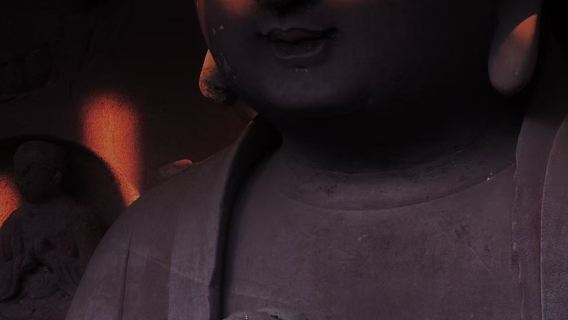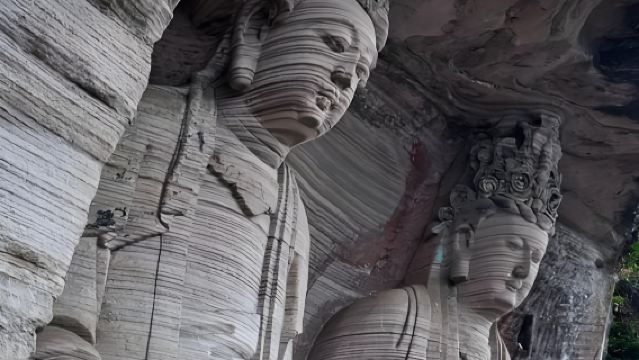

▲ The Anyue Stone Carvings refer to the collective term for the cliffside statue carvings predominantly found in Anyue County, originating from the second year of the Putong era during Emperor Wu of Liang's reign in the Southern Dynasties (521 AD), flourishing during the Tang and Song dynasties, and continuing through the Ming and Qing periods. The carvings feature diverse themes and styles, encompassing both Buddhist and Taoist subjects, showcasing the exquisite craftsmanship and profound cultural heritage of ancient Chinese stone carving art.

▲ The Pilu Cave is located in Youping Village, Shiyang Town, approximately 50 km southeast of Anyue County. It was excavated during the Song Dynasty and extended through the Ming and Qing Dynasties. The site primarily features esoteric Buddhist themes, with the most famous being the "Illustrations of Liu Benzun's Spiritual Journey," which depict his ten ascetic practices, including burning fingers, gouging eyes, and cutting ears, showcasing his spirit of self-mortification. Additionally, the Water-Moon Guanyin statue (commonly known as the Purple Bamboo Guanyin) in Pilu Cave is exquisitely crafted. The figure sits sideways with the right foot raised, breaking the traditional rigid posture of Buddhist statues.

▲ The Grotto of Peacock is located at the foot of Peacock Mountain in Shuanglongjie Township, approximately 55 km southeast of Anyue County, and was carved during the Southern Song Dynasty. It is named after the statue of the Peacock King of Wisdom. The niche features a three-dimensional full-body peacock at its center, with the four-armed Peacock King of Wisdom seated in meditation above it. The unique design and ingenious conception hold significant aesthetic value.

▲ The Huayan Cave is one of the larger and better-preserved grottoes among the Anyue Stone Carvings, named after the "Three Saints of Huayan." Inside the cave stands a 5.2-meter-tall statue of the "Three Saints of Huayan," flanked by seated statues of the "Ten Great Bodhisattvas," each 4.1 meters high. The cave walls are adorned with intricate carvings depicting scenes from Buddhist sutras. The sculptures in Huayan Cave are characterized by their vivid personalities, graceful postures, and well-proportioned figures, closely reflecting real-life aesthetics.

▲ Mingshan Temple is located on Hutou Mountain in Dingxin Community, Shiyang Town, approximately 60 km southeast of Anyue County. It currently houses 63 cliff carvings and 31 stone round sculptures. Most of the statues at Mingshan Temple date back to the Northern Song Dynasty, featuring grand proportions and exquisite decorations. Among them, the statues of Manjusri and the Twelve Guardian Deities are particularly renowned.

▲ The Sleeping Buddha Courtyard is located in Wofo Village, Wofo Town, approximately 25 km north of Anyue County. It features 1,613 cliff carvings and 5 intaglio carvings. The Nirvana of Sakyamuni mural at the Sleeping Buddha Courtyard is one of China's largest left-side reclining Buddha stone carvings from the Tang Dynasty, measuring about 23 meters in length. Both its reclining posture and composition break from traditional Buddhist carving conventions.