






▲ [Important notice for Hong Kong, Macau, Taiwan, and foreign travelers] Thank you for choosing our group tour service. To ensure smooth communication during the itinerary, please note the following: 1. Contact information When placing an order, please be sure to enter your frequently used instant messaging account (supports WeChat). If you use WeChat, you may also send a screenshot of your QR code to the email: 1332231187@qq.com, so we can add you in advance. 2. Communication suggestions Given the Internet environment in the Chinese mainland, WeChat is a more stable and convenient communication method. We strongly recommend that you register and ensure you can sign in normally before departure. 3. Contact before departure Our service staff will add you as a friend via your reserved communication account between 19:00 and 21:00 the night before departure. Please watch for the friend request info at that time. If you haven't received any contact before 21:00, please proactively reach out to Trip.com online customer support for assistance. If you encounter obstacles when adding friends (e.g., unable to find the account), please provide the name of the hotel you're staying at, the hotel's landline number, and your room number in advance so we can relay the message through the hotel. 4. Itinerary time reference The itinerary times listed on the webpage are for reference only. The actual arrangements will be flexibly adjusted by the service staff based on road conditions, weather, and other actual circumstances on the day after communicating with you. Please refer to the final confirmation. 5. Fees & commitments This itinerary is a group package price, all-inclusive with no shopping stops, no optional fees, and no hidden promotions. We focus on providing you with a pure scenic exploration and travel experience. If you have any questions, please feel free to contact Trip.com customer support. Wish you a pleasant journey!

▲ [Itinerary reference] 08:00 pick-up service by certified bilingual guide (meet at Jiefangbei for out-of-range areas) 09:00 Jiefangbei 09:30 Yangtze River Cableway (aerial bus) 10:30 Liziba light rail passing through buildings (viral check-in spot) 11:30 The People's Great Hall 12:00 Lunch not included 13:00 Baigongguan Prison-Zhazidong (Red memory) 14:00 Ciqikou Town (food + old street check-in) 16:00 Shibati + Mountain City Trail 17:00 End tour at Qiansimen (Hongya Cave) 19:30 Watch the lighting on time (Hongya Cave classic night view) Note: The itinerary times and sequence are for reference only. The actual arrangements will be flexibly adjusted by the service staff based on road conditions, weather, and other actual circumstances on the day after communicating with you. Please refer to the final confirmation.
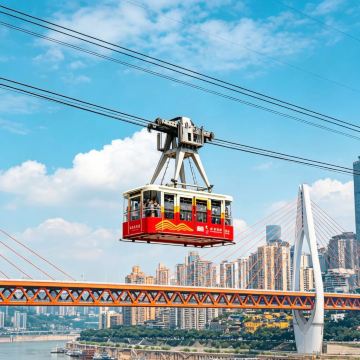

▲ Yangtze River Cableway Riding the Yangtze River Cableway offers a breathtaking aerial view of the confluence of the Yangtze and Jialing rivers, along with a close-up look at the old residential buildings on the Yuzhong Peninsula and the modern skyline of Nanbin Road on the opposite bank. During daytime rides, the clear visibility allows you to fully appreciate the three-dimensional framework of Chongqing's "mountain-river city": on sunny days, you can overlook the two rivers merging at Chaotianmen, even spotting the distinct water color boundary formed by differing sediment concentrations—a natural detail often unnoticed under nighttime lights. As the cableway glides over the old residential clusters of Yuzhong Peninsula, you can also observe the tiered buildings clinging to the mountainside, experiencing the "city perched on cliffs" scenery. Below, boats navigate the rushing river, while skyscrapers and mountain ridges unfold along both banks, revealing the city's daytime textures with remarkable clarity.
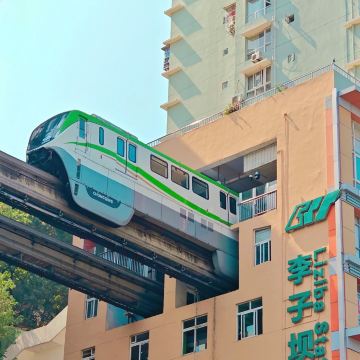

▲ [Liziba light rail passing through buildings] Liziba station is an elevated side platform station on Chongqing rail transit line 2, located on floors 6 to 7 of a 19-story residential building. Trains pass through the building approximately every 2 to 3 minutes. This "light rail through building" view has been widely shared on the Internet and is one of Chongqing's most recognizable urban landmarks. It has also appeared in the movies "I Belonged to You" and "Chongqing Hot Pot." To facilitate travelers' viewing and photography, Yuzhong District built the Liziba viewing platform opposite the station in 2018. Covering an area of about 1,367 m², it can accommodate approximately 5,000 visitors simultaneously. The platform adopts the "golden triangle" photographic composition principle, forming a 33-degree angle with the visual center of the "rail through building" scene.

▲ [Chongqing The People's Great Hall] Chongqing The People's Great Hall is an ancient-style ethnic architectural complex and a representative building combining traditional Chinese palace architecture with Western long-span structures. The hall consists of four parts: the great hall, the east annex, the south annex, and the north annex, covering a total area of 66,000 square meters with a height of 65 m. The circular hall is surrounded by four-tiered overhanging buildings, accommodating over 3,400 people. In the Comparative History of Architecture published by the Royal Institute of British Architects, Chongqing The People's Great Hall ranks second among 42 contemporary architectural works of new China. It was listed in the seventh batch of national key cultural relics protection units and included in the first batch of "Chinese architectural heritage of the 20th century."

▲ Baigongguan Prison Baigongguan Prison was originally the suburban villa of Sichuan warlord Bai Ju, who claimed to be a descendant of Tang Dynasty poet Bai Juyi and named the villa "Xiangshan Villa" after Bai Juyi's pseudonym "Xiangshan Jushi," though locals still called it Baigongguan. It was later converted into a detention center by the military intelligence agency, with over a dozen rooms turned into cells, the basement storage into a dungeon, and the air-raid shelter into a torture chamber. The agency's agents massacred revolutionary figures imprisoned here, though 19 managed to escape. After the founding of the People's Republic of China, Baigongguan Prison became a facility for reforming Nationalist war criminals and was later designated as a national key cultural relics protection unit.

▲ [Zhazidong] Zhazidong was originally a small coal mine for manual coal mining, named for its abundance of slag and scarcity of coal. Surrounded by mountains on three sides and facing a ravine on one side, Zhazidong features treacherous terrain and extreme concealment. Jiang Zhuyun, the real-life inspiration for Sister Jiang in the novel "Red Crag," came from here. One of the most shocking massacres in modern Chinese history occurred here, with only 15 people surviving. After restoration, the former site of the Zhazidong prison became one of the second batch of national key cultural relics protection units.

▲ [Shibati] Shibati is one of the more representative traditional scenic areas in Chongqing's Yuzhong District. Named after the ancient stone-step path connecting the upper city (around Jiaochangkou) with the lower city (around Xiangshui Bridge), the restored Shibati traditional scenic area retains its original stepped layout. The traditional-style buildings now house local snack shops, teahouses and cultural creative stores, making it a great place to experience the local charm of "old Chongqing."

▲ [Ciqikou Town] Ciqikou Town was established during the Northern Song Dynasty, featuring a picturesque landscape of "one river, two streams, three mountains, and four banks." Known as the "first ancient town of Bayu" and "little Chongqing," it fronts the Jialing River and backs against Gele Mountain. During the Ming and Qing Dynasties, it thrived as a bustling water and land port and porcelain trading hub, deriving its name from the homophonic play between "porcelain" and "magnetic." Along its flagstone streets, traditional Sichuan-Chongqing stilted houses stand in harmonious disarray, earning the town the title of a "museum and living fossil" of stilted architecture. The area also boasts local delicacies like spicy blood curd stew, Chen mahua (crispy twists), and salted peanuts, while Bayu folk customs such as Sichuan Opera a cappella and teahouse storytelling add vibrant local charm. A single stroll down its ancient streets unveils a millennium of stories from this mountain city.


▲ [Mountain City Trail] The Mountain City Trail (also known as Mountain City Alley) is one of Chongqing's representative pedestrian systems, connecting old streets, river views, and mountain city scenery. Built along the mountain, it passes by old residential buildings, neighborhood shops, and several viewing platforms overlooking the Yangtze River and Yuzhong Peninsula. Unlike highly commercialized attractions, the Mountain City Trail feels more like part of the city's daily life, offering a genuine and down-to-earth experience of Chongqing.

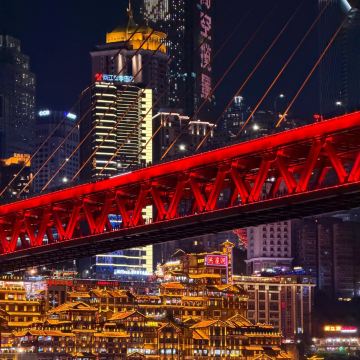
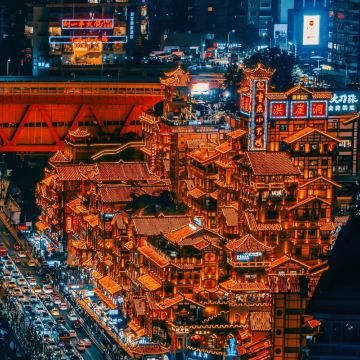
▲ [Qiansimen-Hongya Cave] Hongya Cave is one of the more representative landmarks in Chongqing. This 11-story stilted building complex is built along the river and into the mountainside, integrating dining, shopping, and sightseeing. Qiansimen Bridge spans the Jialing River, connecting Jiefangbei and Hongya Cave, and serves as an ideal spot for capturing panoramic views of Hongya Cave. After nightfall, the tiered lighting of Hongya Cave outlines the stilted houses with warm yellow lights, earning it the reputation of a real-life Spirited Away scene. Viewed from Qiansimen Bridge, the Hongya Cave complex, the reflection on the Jialing River, and the modern skyline of Jiangbeizui complement each other, forming one of Chongqing's most iconic nightscapes.