




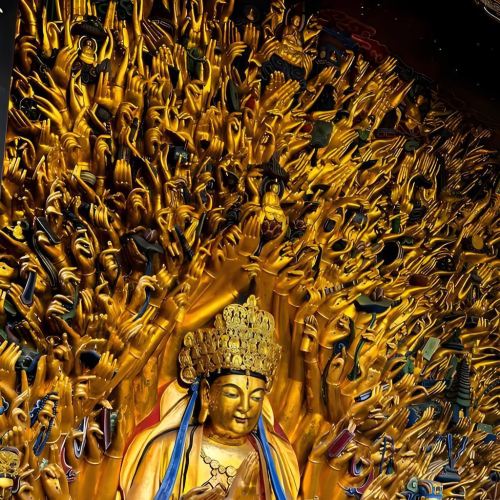
▲ Baodingshan rock carvings, a Song dynasty Buddhist and Taoist grotto complex with cliffside sculptures. One of the Dazu Rock Carvings. Designated as a national key cultural relic protection unit. Located 15 km northeast of Dazu District in Chongqing, the sculptures are primarily concentrated in Dafowan. Initiated by Zhao Zhifeng in 1179 during the Southern Song dynasty's Chunxi era, the project took decades to complete. Dafowan is a deep horseshoe-shaped mountain valley where the grotto sculptures follow the natural contours of the cliffs. Except for the Pilu ritual site and Yuanjue cave which are cavern structures, all others are large-scale cliff carvings. The site features 31 meticulously planned and grandly scaled sculptural ensembles—unique in Chinese grotto art. Major themes include the Huayan Trinity, the magnificent treasure pavilion, the wheel of samsara, the Pilu ritual site, the peacock wisdom king sutra illustrations, scenes of Sakyamuni's birth and nirvana, the thousand-armed Guanyin, Liu Benzun's missionary journeys, hell scenes, Amitayus sutra illustrations, parental devotion sutra illustrations, the ten wisdom kings, Yuanjue cave, and the ox-herding enlightenment scenes. These subjects blend esoteric Buddhism, Chan Buddhism, and Confucian filial piety, representing a visual manifestation of Buddhism's secularization.

▲ The Beishan Rock Carvings are located on Beishan (Longgang Mountain), 2 km north of Dazu Rock Carvings district, Chongqing. They were first carved in the first year of the Jingfu era of the Tang Dynasty (892 AD) and continued until the Shaoxing era of the Southern Song Dynasty, spanning over 250 years. The stone carvings center around the Great Buddha Bay, distributed across five areas including Guanyin Slope, Camp Slope, Buddha Ear Cliff, and North Pagoda Temple. The cliff walls extend over 500 m along the precipice, standing approx. 7 m tall, with 290 existing niches and more than 5,000 statues arranged in a crescent-shaped spatial layout. The themes encompass Esoteric Buddhism, the Three Stages School, and others. Designated as a Sichuan provincial cultural relic protection unit in 1956, it was upgraded to a national key cultural relic protection unit in 1961 and fully inscribed on the World Heritage List in 1999. The statues span three periods: late Tang, Five Dynasties, and Song. Late Tang works inherited the high Tang style, with the Vaisravana niche as a representative piece; Five Dynasties works blended Tang and Song characteristics, introducing new themes like the Bhaisajyaguru sutra illustrations; Song works are renowned for Guanyin group statues, exemplified by the proportioned sculptures and intricate drapery in cave no. 136's revolving sutra repository. Seven extant steles include the Wei Junjing stele and Ancient Text Classic of Filial Piety stele, valued for both military history and calligraphy. The attached Many Treasures Pagoda, built during the Southern Song Shaoxing era, is a thirteen-tiered octagonal brick tower with over 100 Song reliefs embedded. In 2021, a 3D digitization project began for niche no. 245, alongside comprehensive water damage control measures like curtain grouting in the Buddha Bay. Its decorative motif system has drawn attention, with traditional patterns like the Song four-leaf coin design regarded as physical evidence of Chinese ornamental art continuity, now applied in cultural product designs.


▲ The Dazu Rock Carvings Art Museum, a national first-class museum, is located at No. 7 Beishan Road, Longgang Street, Dazu District, Chongqing. It covers an area of 58.5 hectares with a building area of 18,000 square meters, serving as a specialized art museum dedicated to rock carvings. Its main exhibits feature the remains of outdoor cave temples represented by the "Five Mountains" grottoes—Beishan, Baodingshan, Nanshan, Shimenshan, and Shizhuanshan. The museum houses a permanent exhibition titled "Artistic Nirvana: The Dazu Rock Carvings Exhibition" and features facilities such as one of the world's largest 360-degree circular-screen cinemas and an academic lecture hall. As of 2022, the museum's collection includes 820 pieces/sets of cultural relics, with 81 pieces/sets classified as precious relics.