
Things to do in Dabu
Explore top experiences
Top 10 attractions in Dabu

West Lake Park
The park is adjacent to Dapu County Museum and Tai'an Building. There are lakes, pavilions, bridges, trees, flowers and grasses inside the park, which is a good place for leisure walks. The unique iron chain suspension bridge has attracted a large number of people to come and experience it.Dabu · 1.6 km from downtown

Sanhe Ba Battle Memorial Hall
Dabu · 13.1 km from downtown


Ancient City of Chaozhou
The Ancient City Wall of Chaozhou mainly refers to the Xiangqiao District of Chaozhou City. Many historical buildings here have been integrated into modern city life. To experience the unique charm of this ancient city, you can go to Paifang Street and taste traditional food, go to Kaiyuan Temple, Xufu Mafu, and Huang Jilue Ancestral Hall to admire ancient architecture and amazing wood carvings, or take a stroll along the Han River and look at the ancient city walls, the city gate, and the famous Guangji Bridge. If you want to enjoy a nice cup of Chaozhou Gongfu tea, enjoy it by West Lake, where you can take a boat tour.Chaozhou · 76 km from Dabu

Songkou Ancient Town
Songkou Town, Meixian District, Meizhou City is located in the northeast of Meixian District, in the lower reaches of the Meijiang River. It is a small basin surrounded by mountains and rivers. Since the merger of Songkou, Songdong and Songnan, it has become the largest town in Meixian District. Songkou is not only a thousand-year-old town, but also a place where Hakka people live. Songkou's historical sites and natural landscapes are uniquely endowed and have a pattern of their own. So far, many ancient residential buildings have been preserved in various places. Because Songkou Ancient Town has not yet been fully developed, there are few tourists, and its buildings and environmental protection are better.Meizhou · 33.2 km from Dabu

Memorial Temple of Han Yu
Chaozhou Han Wen Gong Temple was built to commemorate Han Yu, a writer and thinker in the Tang Dynasty. Founded in the second year of Song Xianping (AD 999), it is the oldest Korean temple in my country. Han Wen Gong Temple is surrounded by mountains and rivers. The temple records the history of the Han Temple, the achievements of Han Yu in curing tides, and the poems that praise the Han Temple. Climbing up to the Shilang Pavilion, you can also enjoy the beautiful scenery of Chaozhou. Han Yu served as the prefect of Chaozhou for less than eight months. During this period, he exorcised evil, supported farmers, redeemed slaves, established education, made outstanding contributions to the development of Chaozhou, and won the respect and memory of Chaozhou people.Chaozhou · 76.1 km from Dabu

Nan'ao Island
Nan'ao Island is an island county located on the border between Guangdong Province and Fujian Province. Nan'ao Island has not been opened up extensively. The scenery still retains its original natural beauty. The sea water is clear and the sand quality is superior. In addition to the natural landscape, the island contains historical sites such as the Nan'ao Zongbingfu and the Song well. This place has many kinds of seafood, which is tasty and inexpensive. So this is a great place to eat seafood while watching the sea.China · Nan'ao County

Quanzhou Kaiyuan Temple
Kaiyuan Temple is located in QuanzhouWest Street, Licheng DistrictBuilt in the second year of the Chuigong era during the reign of Empress Wu Zetian of the Tang Dynasty, it has a history of over 1,300 years. It is an important cultural relic along the southeastern coast of China and one of the larger-scale Buddhist temples in Fujian Province. The attractions of the monastery are arranged along the central axisWorship pavilion, the Baiting, the main hall of Kaiyuan Temple, the Sangpeng historic site, the Kaiyuan Temple's Sweet Dew Ordination Platform, the scripture depository, etc.Also,, as well as the stone pagodas on the east and west sides and the east and west corridors. Quanzhou Kaiyuan Temple - The heavenly king hall, also the mountain gate of the temple, was built in 1925. The stone pillars are slightly thinner at the top and bottom, thicker in the middle, shaped like a shuttle, reflecting the Tang dynasty stone pillar style. A wooden couplet hangs on the stone pillars, reading "This place is called the land of Buddha, where every street is filled with saints." It was composed by Zhu Xi, a great Neo-Confucian scholar of the Southern Song dynasty, and written by the modern eminent monk Hongyi. Crossing the mountain gate brings you toWorship pavilionStanding here, you can see the east and west pagodas rising from the ground and the spacious, bright east and west corridors symmetrically arranged on both sides. The east and west pagodas are among the more famous attractions in the area. The east pagoda is called "Zhenguo Pagoda (East Pagoda)," while the west pagoda is named "Renshou Pagoda." Standing over 40 m tall, they are one of the tallest pairs of stone pagodas in China and serve as landmarks and symbols of the ancient city of Quanzhou. Worship pavilionIn front, there is a large stone courtyard where officials and commoners from ancient and modern times gather for activities, becoming particularly lively during events. On both sides of the stone courtyard stand eight large banyan trees, beneath which are arranged 11 ancient sutra pillars and small stupas from the Tang, Song, and Ming dynasties in various styles, as well as two stone tortoises. Then there is the main structure, the Mahavira Hall of Kaiyuan Temple. The Mahavira Hall of Kaiyuan Temple also has an elegant name, "Hundred-Pillar Hall." Originally, the hall was planned to have one hundred pillars, but later, to accommodate the placement of Buddha statues and create space for Buddhist activities, the beams were extended, and the number of pillars was reduced, resulting in the "Hundred-Pillar Hall" with 86 pillars.China · Quanzhou

Jiangnan Songcheng Historical And Cultural Tourism Area
Jiangnan Songcheng Historical and Cultural Tourist Area is located in Hetao Old Town, Zhanggong District, Ganzhou City at the intersection of Zhangjiang River, Gongjiang River and Ganjiang River. It is a national 4A-level scenic spot. Covering an area of 143 mu, it includes five historical and cultural blocks (Yugutai, Yao Yaqian, Zaoer Lane, Nanshi Street, and Ciguling) and one block with traditional features (Xingannan Road) and the area where cultural preservation units are located. Within the block, there are Yugu Terrace, Song City Wall, Bajing Terrace, Chiang Ching-kuo's Former Residence, and the Site of the Special Committee of the Communist Party of China, etc., including Yangming Academy, Guangdong Guild Hall, Former Residence of Li Zhengdao (Nobel Prize Winner), Zhang Leping (famous cartoonist) Home, the former residence of the author of Sanmao Wanderings), Huichang Xue Mansion, Anyuan Xue Mansion, Longnan Xue Mansion, Jiuhua Ancient Pavilion and other historical buildings. Since the operation of the Jiangnan Songcheng project, the establishment of a national 4A-level tourist attraction has been completed within 3 months, and it has won the top ten cultural and tourism integration demonstration projects in Jiangxi Province, the 2020 provincial modern service industry cluster, the first batch of provincial night cultural tourism consumption clusters, Jiangxi Provincial Tourism and Leisure Block, Provincial Commercial Block Renovation Pilot Block and many other honorary titles were selected as the first batch of Ganzhou Intangible Cultural Heritage Town and the third batch of Zhanggong District Youth Comprehensive Practice Base. Among them, the intelligent detection and management system for the protection of historical and cultural blocks in Ganzhou City, "Song City on the Cloud", has also become a typical case of cultural and tourism informatization development in Jiangxi Province.China · Ganzhou

South Shaolin Temple
First built during the Longshuo era and abandoned in the Tianyou era. According to Cai Yongjian's "Xishan magazine" from the Qing Dynasty, which cited the Tang Dynasty's "Minzhong records," before the first year of Longshuo in the Tang Dynasty (661 AD), "Zhikong entered Minzhong and built the Shaolin Temple at the foot of Qingyuan Mountain, consisting of thirteen courtyards." "The Shaolin Temple had thirteen sections, surrounded by walls three zhang high, with vast fields and lush forests." "Beside the celestial altar stood the Shaolin Temple, where Zen master Zhikong met with Governor Wang at the celestial altar." Zhikong (styled Daoguang) was one of the thirteen staff-wielding monks from the Songshan Shaolin Temple renowned for saving the Tang emperor. His arrival in Min marked the beginning of martial monks in Fujian, and he trained twelve disciples—some capable of capturing tigers or lifting massive cauldrons, others skilled in wielding heavy crossbows, mastering chain hammers, or moving with extraordinary speed... The "Minzhong records" also states: In the first year of the Tang Tianyou era (907), "the Shaolin Temple rebelled against Wang Shenzhi's allegiance to the Liang Dynasty and was destroyed." Shi Mengshuo of the Southern Song Dynasty wrote in his "Donglu poetry collection": "The Shaolin Temple was built in Qingyuan, with ten grand gates and towering walls; a hundred acres of fields across three ridges, where a thousand monks practiced martial arts to rebel against the Wang regime." The "Wang regime" refers to the Min King Wang Shenzhi. Wang Shenzhi's destruction of the South Shaolin Temple in Quanzhou marks its first destruction. Prospered during the Taiping Xingguo era and declined during the Zhiyuan era The "Xishan magazine" records that in the sixth year of the Taiping Xingguo era of the Northern Song Dynasty (981 AD), an imperial decree was issued to rebuild the South Shaolin Temple in Quanzhou. This marked the second revival of the South Shaolin Temple in Quanzhou. Liu Changyan of the Northern Song Dynasty wrote in his poem: "The legacy of Qingyuan was built during the Xingguo era, the Shaolin spirit pervades throughout southern Quanzhou." "Xingguo" refers to the reign era of Emperor Taizong of Song, Taiping Xingguo (976–983). A copy of the Zhang family genealogy preserved in Donghu village, Dongqiao town, Hui'an county, states: "Shizhi, styled Fayi, renowned for stone carving, his craftsmanship was unparalleled, such as the stone lions in front of the Shaolin Temple in Quanzhou..." Zhang Shizhi was the younger brother of Zhang Shixun, a figure from the Song Dynasty, indicating his involvement in carving the stone lions at the entrance of the Shaolin Temple in Quanzhou during the Song Dynasty. Northern Song Dynasty records document that the South Shaolin Temple originally comprised a mountain gate, Mahavira Hall, dharma hall, Bodhidharma ancestral hall, thirteen halls, arhat hall, xuannü hall, scripture repository, heavenly king hall, Guanyin hall, Ksitigarbha hall and other supporting facilities, covering 400 mu of land. During the 2002 reconstruction of the heavenly king hall, over 40 stone temple components were excavated underground, including 1 pagoda base, 1 pagoda cover, 7 finials resembling those of Yinggeng Pagoda at Chengtian Temple, 4 stone caps, 4 column bases, 6 stone pillars, and notably 20 intact mortise stones measuring 1 m in diameter - all testifying to the temple's grand architectural scale. Numerous roof tiles and covers were also unearthed. Experts speculate these components likely belonged to the Quanzhou South Shaolin Temple's structures during the Tang and Song dynasties. During the peak periods of the Tang and Song dynasties, the temple housed thousands of martial monks. The "Xishan magazine · general records" also records: "In the first year of the Song Jingyan era (Yuan Dynasty's Zhiyuan 13th year, 1276), a thousand monks from the Qingyuan Shaolin Temple rebelled against Pu Shougeng's surrender to the Yuan Dynasty. The abbot of the Shaolin Temple, Yuan Miao... commonly known as Zhao Mengliang... (Yuan troops) pursued them to the Shaolin Temple... The vanguard, Qi Wotunsi, known for his cruelty, ordered an assault on the Shaolin Temple, provoking the fury of the thousand monks. Amidst the clash of swords, each monk fought like ten, leaving Yuan soldiers' corpses strewn across the east of Qingyuan city, with bones littering the fields. When Suodu arrived, he ordered arrows to be shot, killing most of the thousand monks, with only a hundred surviving... The survivors fled to Dehua (Daiyun Temple)." This marks the second destruction of the South Shaolin Temple in Quanzhou. In the mid-Ming dynasty, Li Sen (born in 1398), a wealthy philanthropist from Anxi, funded the purchase of large tracts of wasteland on Dongyue Mountain to establish charitable burial grounds for the free interment of remains by Quanzhou residents. These burial sites appear to have been the same wastelands where the Shaolin Temple was destroyed after its thousand monks resisted the Yuan dynasty in the late Southern Song period. Prospered during the Hongwu era and declined during the Qianlong era The "Xishan magazine" records: In the tenth year of the Hongwu era of the Ming Dynasty (1377 AD), Faben of the Xuanmiao Temple (a Shaolin monk who fled to Dehua after the resistance of a thousand monks against the Yuan Dynasty in the late Song period, aged 135) persuaded the local official Huang Zhongli to "petition the court for imperial approval to rebuild the Shaolin Temple." The monks then spread martial arts throughout southern Quanzhou. This marked the third revival of the South Shaolin Temple in Quanzhou. The Annals of Jinjiang County, Volume 69, from the Daoguang era of the Qing Dynasty records: "The South Shaolin Temple is located by the East Lake outside Renfeng... It was rebuilt in the 10th year of the Xuande era (1435) during the Ming Dynasty, but later fell into disrepair. Monks restored one-tenth of its original site and also enshrined County Magistrate Peng Guoguang, as Peng had helped monks reclaim temple lands." In the book "Records of Shaolin warrior monks" by master Deqian of the Shaolin Temple on Mount Song (published by Beijing Sports University Press, 1988), it is stated: "According to the 'Internal Chronicles of Shaolin Temple,' monk Yuanran possessed extraordinary martial arts skills and was commended by Emperor Jiajing of the Ming Dynasty (reigned 1522-1566). His eminent disciple, master Yuekong, was ordered to lead over 30 warrior monks who had proven their skills to Quanzhou, Fujian, to suppress Japanese pirates and establish merits. There, they built the South Shaolin Temple, where he became the abbot." This confirms that the "Internal Chronicles of Shaolin Temple" from the northern Shaolin Temple clearly records the existence of a South Shaolin Temple in Quanzhou during the Ming Dynasty, while the claim of it being newly built is a misconception. To this day, southern Fujian still circulates stories of northern Shaolin warrior monks suppressing Japanese pirates. During the Qianlong era of the Qing Dynasty, Emperor Qianlong toured southern China and feared that the warrior monks of the South Shaolin Temple might collude with the remnants of Zheng Chenggong (see "Quanzhou biographical records: Zheng Chenggong"). "In the fall of the 28th year of Qianlong's reign (1763), an imperial decree ordered the burning of the Shaolin Temple... From then on, no one dared to rebuild it." Some temple monks took refuge at Yipian Temple in Nan'an. This marks the third destruction of the South Shaolin Temple in Quanzhou. After the burning of Shaolin Temple, the monk Zhishan sought refuge among the people, continuing to recruit Shaolin disciples to oppose the Qing dynasty and restore the Ming. Zhishan, Hong Xiguan, and their disciples spread to Guangdong, further developing Southern Shaolin boxing, which produced the Southern Shaolin boxing champion Wong Fei-hung. Later, Wong Fei-hung's disciples brought the art to Hong Kong and spread it as far as the United States.China · Quanzhou

Xiamen University (Siming Campus)
Xiamen University was founded in 1921 by Mr. Tan Kah Kee, a renowned patriotic overseas Chinese leader, marking the first university established by overseas Chinese in modern Chinese educational history. For a century, the university has upheld its founder's vision, cultivating a distinguished ethos of "patriotism, revolution, self-improvement, and science." With its distinctive educational approach, it has nurtured generations of outstanding talents, making significant contributions to national prosperity, public welfare, and the global dissemination of Chinese culture. The Siming campus is the main campus of Xiamen University, located in Siming District, Xiamen, at the southern tip of Xiamen Island. Nestled between mountains and sea, it is renowned as the "garden university by the sea." The campus features numerous landmark buildings and comprehensive teaching and living facilities, with the Jiageng Building Complex (also known as the Songen Building Complex) standing as its iconic cross-century architectural masterpiece. Completed in 2001 to commemorate the university's 80th anniversary, this complex consists of five buildings: Songen Tower (the main building), Baoxin Liying Building, Chengfeng Building, Zuying Building, and Zhongmingxuan Building. Designed with a symmetrical "one-main-four-auxiliary" layout, the 21-story Songen Tower serves primarily as the administrative center, while the other four six-story buildings are dedicated to public teaching and research. The architectural style inherits and evolves the distinctive "Jiageng Style," featuring red-tiled sloping roofs that harmonize with the campus's historic structures. This fusion of Chinese and Western elements creates a modern complex with contemporary character, forming the landmark core that dominates the campus landscape.China · Xiamen
Experiences you can't miss in Dabu
Featured Food & drink in Dabu
View all Food & drink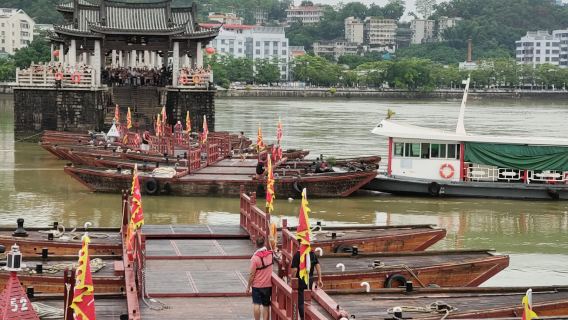
Free cancellation
Book now for tomorrow
FromMXN3,318.59
![Fujian Longyan Yongding Hongkeng tulou + Hakka glutinous rice wine tasting [roam Zhencheng Building + experience intangible cultural heritage]](https://ak-d.tripcdn.com/images/0352312000tt84av1A367_C_568_320.jpg?_fr=wc)
Free cancellation
Instant confirmation
FromMXN2,403.21

Free cancellation
Instant confirmation
Book now for today
FromMXN550.34
Free cancellation
Instant confirmation
Book now for today
FromMXN1,626.11
Featured Day tours in Dabu
View all Day tours

4.9/5
· 9.3k reviews· 34.4k bookedFree cancellation
Book now for tomorrow
100 consecutive positive reviews
FromMXN3,816.38
One-Day Tour from Xiamen to Nanjing Yunshuiyao and Yongding Tulou Cluster - Experience Hakka Culture
4.7/5
· 41 reviews· 444 bookedFree cancellation
Instant confirmation
Book now for tomorrow
95.1% of travelers recommend
Save MXN11.53
FromMXN1,140.76MXN1,152.29
4.9/5
· 63 reviews· 563 bookedFree cancellation
Instant confirmation
Book now for tomorrow
63 consecutive positive reviews
FromMXN2,486.18
5.0/5
· 10 reviews· 100 bookedFree cancellation
Instant confirmation
Book now for tomorrow
Save MXN10.27
FromMXN1,016.92MXN1,027.19

4.6/5
· 14 reviews· 93 bookedFree cancellation
Instant confirmation
Book now for tomorrow
Save MXN10.38
FromMXN1,027.5MXN1,037.88

4.7/5
· 3 reviews· 53 bookedFree cancellation
Instant confirmation
Book now for tomorrow
Save MXN16.92
FromMXN1,674.91MXN1,691.83

4.9/5
· 25 reviews· 37 bookedInstant confirmation
Book now for tomorrow
Save MXN14.99
FromMXN1,484.89MXN1,499.88
5.0/5
· 4 reviews· 28 bookedInstant confirmation
Book now for tomorrow
FromMXN1,317.68
Featured Cultural experiences in Dabu
View all Cultural experiences
4.7/5
· 3 reviews· 73 bookedFree cancellation
Instant confirmation
Book now for tomorrow
FromMXN326.33

Free cancellation
Instant confirmation
Book now for tomorrow
FromMXN939.64
3.7/5
· 3 reviewsFree cancellation
Book now for tomorrow
FromMXN406.53

FromMXN3,142.6
Free cancellation
Instant confirmation
Book now for tomorrow
FromMXN215.71

Free cancellation
Instant confirmation
Book now for tomorrow
FromMXN177

Free cancellation
Instant confirmation
Book now for tomorrow
FromMXN215.71
Free things to do in Dabu
West Lake Park
Dabu · 1.6 km from downtownSanhe Ba Battle Memorial Hall
Dabu · 13.1 km from downtownAncient City of Chaozhou
Chaozhou · 76 km from DabuSongkou Ancient Town
Meizhou · 33.2 km from DabuMemorial Temple of Han Yu
Chaozhou · 76.1 km from DabuImmediate access, Book now for today, Cancel anytimeNan'ao Island
China · Nan'ao CountyQuanzhou Kaiyuan Temple
China · QuanzhouJiangnan Songcheng Historical And Cultural Tourism Area
China · GanzhouImmediate access, Book now for today, Cancel anytimeSouth Shaolin Temple
China · QuanzhouXiamen University (Siming Campus)
China · Xiamen
More ways to travel from Dabu
What travelers say about Dabu

L-Y-NFebruary 19, 2021
4.0
West Lake Park is located in the center of Tai Po city. It is a free tourist attraction. There is a fountain in the center of the lake and the scenery is nice. There is a food culture center nearby and a free parking lot. It is worth a visit.
West Lake Park

charlesSeptember 8, 2020
5.0
The memorial hall is about ten minutes' drive from Tai Po Railway Station, and you can take a train to visit it. Many people know that Jinggangshan is a revolutionary base, but they don't know that there would be no Jinggangshan base without the victory of the Sanheba Battle.
Sanhe Ba Battle Memorial Hall

M56***38March 28, 2026
5.0
I came here because of its reputation, and visited Chaozhou Ancient City, Guangji Bridge, Guangji Tower, and Kaiyuan Temple to learn about Chaoshan culture and taste local delicacies. In March, the spring sunshine was just right, the weather was pleasant, and I felt very comfortable.
Ancient City of Chaozhou

勇敢的哥March 13, 2025
5.0
松口古镇坐落于广东省梅州市梅县区东北部,地处梅江下游,依山傍水,自古便是粤东地区的交通枢纽与商贸中心。自秦汉时期开埠,松口历经千年沧桑,素有“南洋第一古镇”之称。历史上,这里是客家人下南洋的重要出发港,无数青壮年从松口乘船远渡重洋,形成了庞大的侨乡网络,至今仍保留着浓郁的客家文化与华侨风情。
Songkou Ancient Town

_We***68October 8, 2026
5.0
After visiting the Thai Buddhist Hall at Kaiyuan Temple, a taxi ride cost just over three yuan took me directly to Han Yu's Ancestral Hall. Walking there would have been 1.8km, which would have been quite tiring. Taxis are relatively cheap in Chaozhou. This place mainly introduces the life of Han Yu from the Tang Dynasty, his contributions during his exile to Chaozhou, and praises his patriotism and dedication to the people. It's worth taking a short stroll, as the reservation ticket is free, essentially like visiting a small park. The ticket entrance for Guangji Bridge is just over 100 meters away. After visiting Guangji Bridge, you can go directly there to experience the culture and charm of a pontoon bridge before returning to the ancient city, avoiding backtracking.
Memorial Temple of Han Yu

stanwzgAugust 6, 2026
4.0
We didn't catch any squid, but the owner helped us by casting a net every half hour, bringing up quite a few. We had a barbecue on the boat, which was a nice way to relax and have some fun in the evening. Even though we didn't catch any fish, we still had a barbecue and seafood porridge dinner.
Nan'ao Island

菁菁 者莪July 23, 2026
5.0
Kaiyuan Temple, a thousand-year-old temple, boasts imposing twin pagodas and towering banyan trees, offering a tranquil escape from the bustling city. Just a wall away lies West Street, a vibrant hub of activity, with its exquisitely carved ancient buildings that blend the diverse cultures of the Maritime Silk Road, making it a worthwhile destination to savor and appreciate the rich heritage of Quanzhou.
Quanzhou Kaiyuan Temple

Levis-LiMay 4, 2026
4.0
As expected of Songcheng, it's really good. First of all, the environment is nice, and the prices are incredibly low. For example, a cup of green tea is only 6 yuan, and you can even get refills! The most interesting thing is the courtesan's dance! It's truly excellent!
Jiangnan Songcheng Historical And Cultural Tourism Area
300***34October 7, 2026
5.0
The performance, priced at around seventy yuan, was well worth it. The Shaolin monks all gave their all, and the applause was constant throughout the performance. This was not only an affirmation of their performance but also a praise and expression of confidence in the spirit of traditional Chinese martial arts. There was especially a cute little monk, about four or five years old, who could even make a hand gesture, eliciting constant laughter.
South Shaolin Temple

夜空星城August 3, 2026
5.0
Walking around Furong Lake after entering the school gate is a pleasant experience. The red brick and green tile buildings in the Jiarong style are pleasing to the eye, and the large trees along the road provide shade, keeping you cool and dry. I didn't feel tired even after strolling around for half a day. The overall atmosphere is quiet and perfect for leisurely exploration.
Xiamen University (Siming Campus)


